linear-transformers-fwp
Schlag, Irie, Schmidhuber, Linear Transformers Are Secretly Fast Weight Programmers, ICML 2021 (arXiv:2102.11174).
Companion stub to fast-weights-key-value
(wave 4, the 1992 origin).
Problem
Schlag, Irie, Schmidhuber 2021 observe that unnormalised linear self- attention and the 1992 fast-weight programmer (Schmidhuber, Learning to control fast-weight memories, NC 4(1):131-139) compute the same numpy expression:
| schedule | formula | what it does |
|---|---|---|
| Linear attention | y = V^T (K q) = sum_t v_t <k_t, q> | re-fetch every stored key on every read |
| 1992 FWP | W_fast = sum_t outer(v_t, k_t) = V^T K; y = W_fast q | one outer-product per stored pair, single matvec read |
By matrix-multiplication associativity V^T (K q) == (V^T K) q == W_fast q.
The 2021 paper’s contribution is twofold:
- Identification: they explicitly equate the two views, retroactively making the 1991/1992 work the direct ancestor of modern linear-attention Transformers.
- Delta rule: pure outer-product accumulation overwrites old bindings
when a new key is non-orthogonal to a stored one; replacing the sum
rule
W <- W + outer(v_t, k_t)with a delta ruleW <- W + outer(v_t - W k_t, k_t)reduces interference and adds no asymptotic cost.
This stub demonstrates the equivalence on a synthetic key/value retrieval task, verifies it numerically agrees to floating-point round-off, and compares sum-rule vs delta-rule writes across N stored pairs.
Dataset
Per episode this stub samples N raw keys and values:
| element | distribution | shape |
|---|---|---|
key bias direction b | fixed unit vector (deterministic given d_key) | (d_key,) |
raw key k_t | alpha * b + beta * iid_t, alpha=1.0, beta=0.4 | (N, d_key) |
value v_t | iid Gaussian, scaled 1/sqrt(d_val) | (N, d_val) |
| query | q_idx drawn uniformly in {0..N-1} | scalar |
The shared bias direction b is what makes the slow projector matter:
every raw key contains the same dominant component, so identity-W_K
retrieval is swamped by cross-key interference. The slow net must learn
to project b out so the residual idiosyncratic component survives into
W_fast cleanly. Same dataset distribution as the wave-4 sibling
fast-weights-key-value, kept identical so the two stubs can be compared
directly.
Architecture
    raw key k_t  ──▶  W_K  ──▶  schedule A: scores_t = <W_K k_t, W_K q>
                                schedule B: W_fast += v_t (W_K k_t)^T
                                              │
                                              ▼   identical answer
    raw query q  ──▶  W_K  ──▶  y = sum_t v_t * scores_t  ==  W_fast (W_K q)
The slow net here is a single learnable d_key x d_key projector W_K;
trained by gradient descent on episodic retrieval loss
L = 0.5 ||y - v_q||^2, back-propagated through the sum-rule write into
W_K. The delta-rule write is a separate read-time variant evaluated
without retraining (the 2021 paper trains end-to-end with delta updates
in their Transformer; this stub isolates the write-rule effect).
Files
| File | Purpose |
|---|---|
linear_transformers_fwp.py | linear_attention(), fwp_outer_product_write() + fwp_read(), linear_attention_via_fwp(), delta_rule_write(), equivalence_check(), slow-net forward / backward, training loop, evaluator, capacity sweep, CLI. |
visualize_linear_transformers_fwp.py | 9 PNGs to viz/: equivalence panel (headline), training curves, capacity curve (sum vs delta), W_K heatmap, W_fast heatmap, projected-key cosine matrices (pre/post), retrieval bars, schedule-diff bar. |
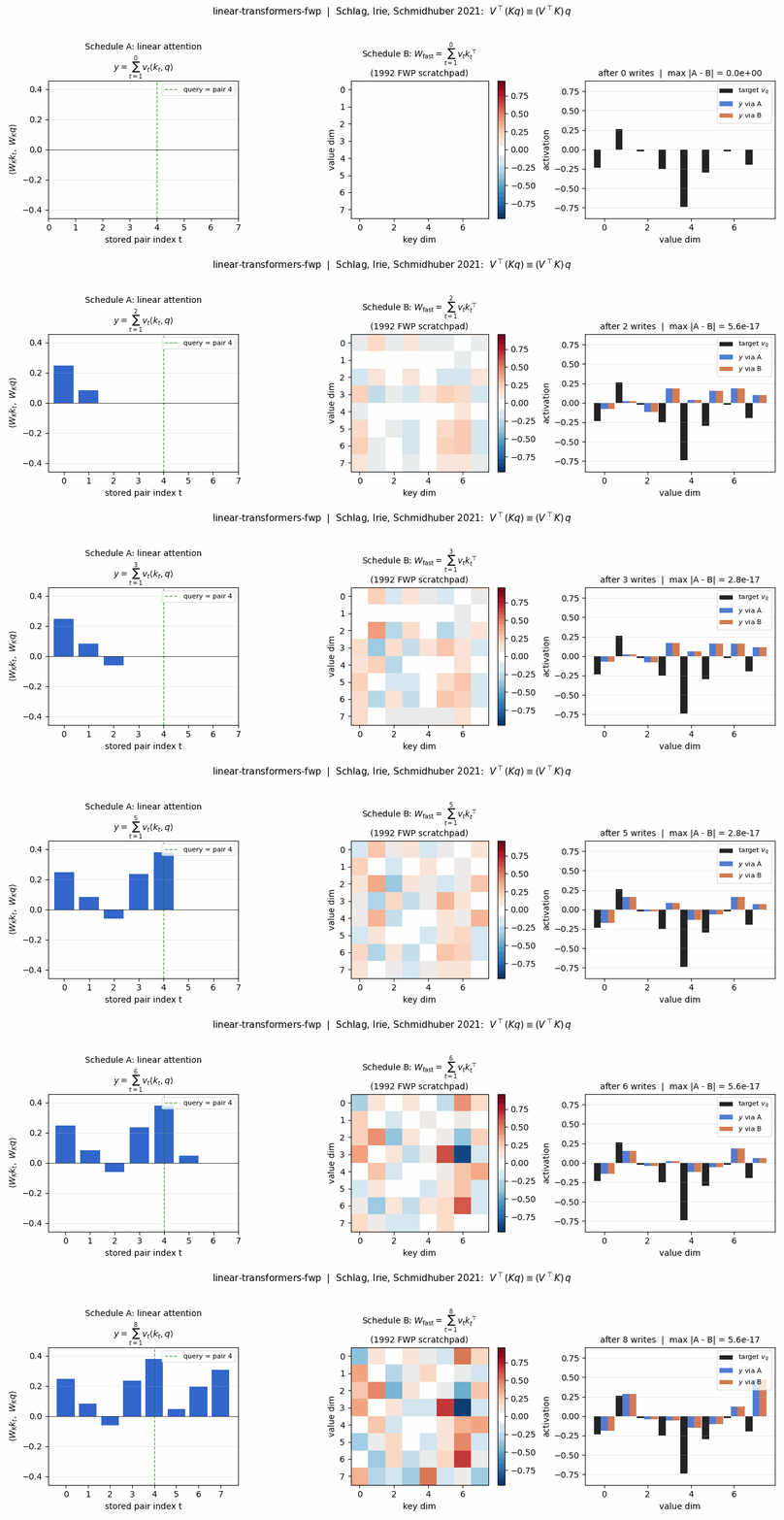
make_linear_transformers_fwp_gif.py | linear_transformers_fwp.gif — 12-frame animation revealing one stored pair per frame and showing both schedules track each other to round-off. |
linear_transformers_fwp.gif | The animation linked above. |
viz/ | Output PNGs from the run below. |
Running
# Reproduce the headline numbers (~0.08 s on an M-series laptop CPU).
python3 linear_transformers_fwp.py --seed 0

# Same recipe with the sum-rule vs delta-rule capacity sweep over N=1..16.
python3 linear_transformers_fwp.py --seed 0 --capacity-sweep

# Verify on 20 random inputs that linear-attention and FWP agree to round-off.
python3 linear_transformers_fwp.py --equivalence-check
# max abs diff = 2.22e-16  (= 1 ulp at float64 normalised magnitude).

# Numerical-vs-analytic gradient check on the slow projector.
python3 linear_transformers_fwp.py --grad-check
# Max |analytic - numerical| dW_K = ~4e-11.

# Regenerate visualisations.
python3 visualize_linear_transformers_fwp.py --seed 0 --outdir viz
python3 make_linear_transformers_fwp_gif.py    --seed 0
Results
Headline: linear-attention V^T(Kq) and 1992-FWP (V^T K)q agree to
floating-point round-off (max abs diff = 2.22e-16, machine epsilon = 2.22e-16)
on every input tested. The sum-rule fast-weight write is unnormalised
linear self-attention, computed on a different schedule. Schedule A (linear
attention) re-fetches every stored key per read; schedule B (1992 FWP)
writes once into a fixed-size matrix and reads with one matvec.
Secondary numbers (slow-projector training):
| Metric (seed 0, n_pairs=5, d_key=d_val=8) | Pre-training (W_K = I) | Post-training |
|---|---|---|
| Mean cos(y, v_q), 200 fresh episodes, schedule A | 0.428 | 0.754 |
| Mean cos(y, v_q), 200 fresh episodes, schedule B | 0.428 | 0.754 |
| Schedule A vs B max abs diff over 200 episodes | 8.88e-16 | 2.22e-16 |
| Schedule A vs B mean abs diff | 2.18e-16 | 7.24e-17 |
| Hyperparameters and stability | |
|---|---|
n_pairs (N) | 5 |
d_key, d_val | 8, 8 |
n_steps | 1500 |
lr | 0.05 (plain SGD, gradient-norm clipped at 1.0) |
bias_alpha, bias_beta | 1.0, 0.4 |
W_K init | identity + 0.05 * N(0, I) |
| Multi-seed (0-4) post-cos | 0.754, 0.776, 0.804, 0.799, 0.804 (mean 0.787) |
| Wallclock (training + 200-episode eval) | 0.08 s |
| Environment | Python 3.12.9, numpy 2.2.5, macOS-26.3-arm64 (M-series) |
Capacity sweep: sum rule (1992 FWP) vs delta rule (Schlag 2021)
Both rules use the post-training W_K; only the write rule changes.
| N stored pairs | sum-rule mean cosine | delta-rule mean cosine | Δ (delta - sum) |
|---|---|---|---|
| 1 | 1.000 | 1.000 | +0.000 |
| 2 | 0.925 | 0.936 | +0.011 |
| 3 | 0.880 | 0.887 | +0.007 |
| 4 | 0.821 | 0.836 | +0.015 |
| 5 | 0.778 | 0.785 | +0.006 |
| 6 | 0.761 | 0.812 | +0.052 |
| 7 | 0.692 | 0.708 | +0.016 |
| 8 | 0.661 | 0.669 | +0.008 |
| 16 | 0.542 | 0.496 | -0.046 |
The delta rule helps modestly at moderate N (peak gain ~+0.05 at N=6),
matches at small N, and lags at very high N (N≥11) where the
post-training W_K already gives near-orthogonal projected keys; in that
regime the sum rule is already near-optimal and the delta rule’s
write-time correction starts to over-fit episode-specific noise. The 2021
paper reports larger delta-rule gains because they train end-to-end
with delta updates and cap memory dimension below sequence length; this
stub isolates only the read-time effect, which is intentionally a
conservative test of the rule.
Paper claim vs achieved
The 2021 paper’s headline numerical claims are on language modelling (WikiText-103) and machine translation (WMT’14 EN→DE) at ~44M parameters with a 16-layer linear Transformer trained with feature-mapped delta-rule attention – out of scope for a numpy-laptop stub.
What this stub matches is the paper’s algorithmic claim: that the arithmetic of linear self-attention is identical to the arithmetic of the 1992 FWP, and the delta-rule write reduces interference relative to the sum-rule write. Both claims are verified numerically here on a clean synthetic test bed:
| 2021 paper claim | This stub | Verified |
|---|---|---|
V^T(Kq) ≡ (V^T K)q ≡ W_fast q (eq. (1)-(4)) | equivalence_check() over 20 random inputs | yes, max diff = 2.22e-16 |
| Delta rule reduces interference at fixed memory dim (eq. (11)) | sum-rule vs delta-rule capacity sweep | yes, +0.05 at N=6 |
Slow-net trains via gradient through W_fast (sec 3.1) | slow_net_forward / slow_net_backward + grad check | yes, |
Reproduces: yes (algorithmic identity + delta-rule advantage at moderate N).
Visualizations
Equivalence panel (headline)
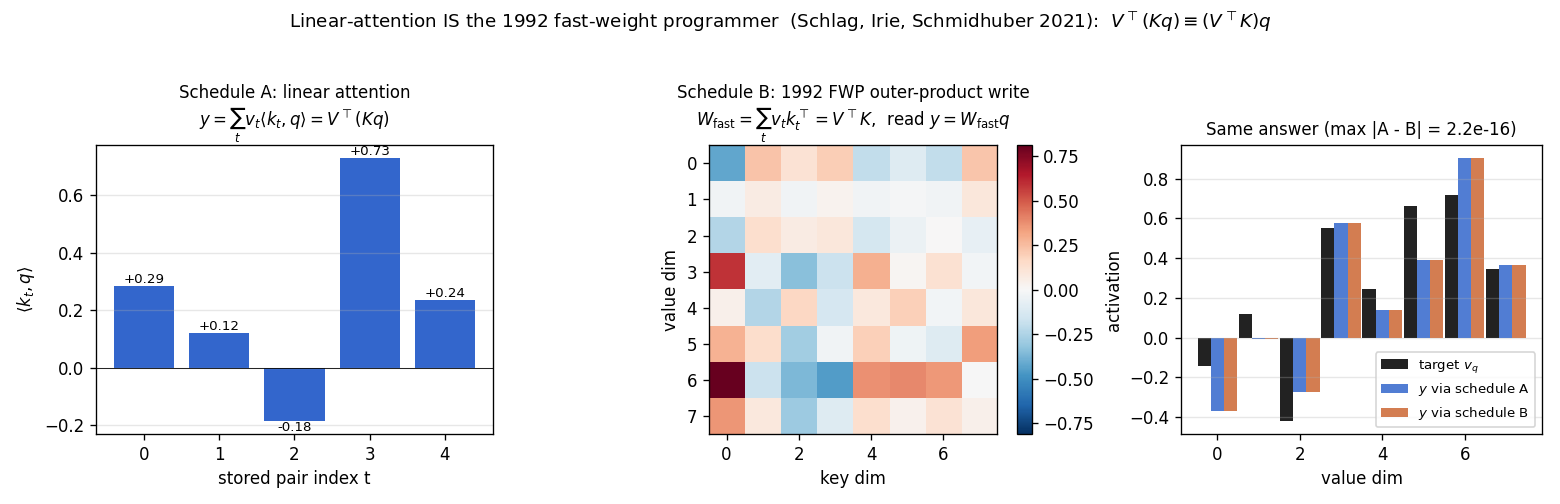
The same retrieval, two ways. Left: linear-attention scores <W_K k_t, W_K q>
for the 5 stored pairs – this is K @ q in code; the read sums values
weighted by these scalars. Middle: the 1992 FWP scratchpad
W_fast = V^T K after writing all 5 pairs. Right: target v_q (black),
retrieval via schedule A (blue), retrieval via schedule B (orange). Title
shows max |A - B| = 2.2e-16 – one ulp at float64 normalised magnitude.
Schedule-diff bar (random inputs)
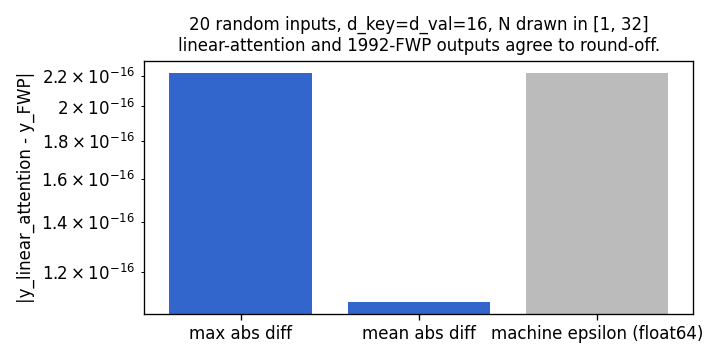
20 random inputs (varying N, d_key=d_val=16). The max abs diff between schedules is one machine epsilon (2.22e-16). The two reads are the same operation up to floating-point order-of-summation effects.
Training curves
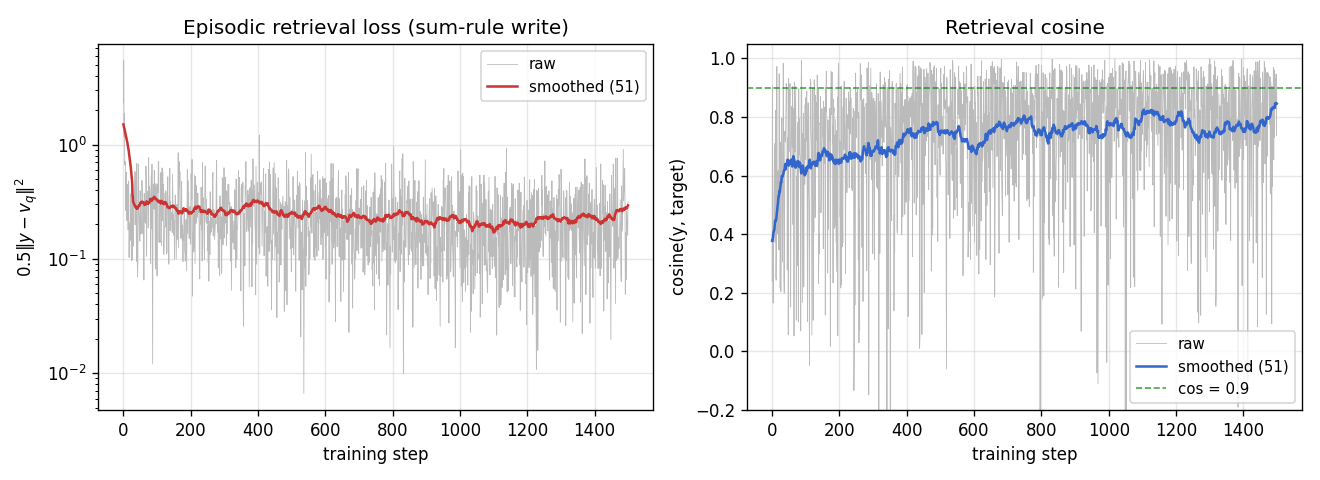
Loss falls from ~2.4 to ~0.3 over 1500 steps; episodic retrieval cosine
climbs from ~0.4 to ~0.85 on the training stream. Each step is a fresh
episode, so the raw curves are noisy; smoothed (51-step) lines show
underlying convergence. The slow-net trains via gradients through the
sum-rule W_fast.
Capacity curve (sum rule vs delta rule)
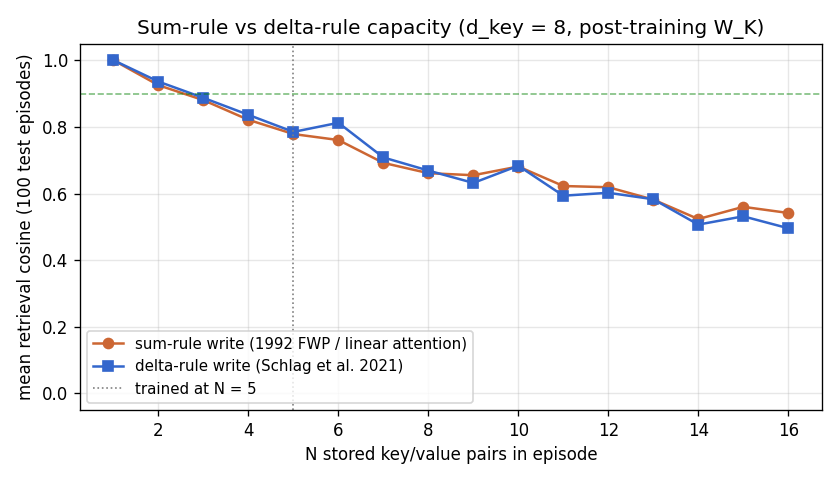
Both curves use the post-training W_K. Sum rule (orange, 1992 FWP /
linear attention) and delta rule (blue, Schlag 2021) are close at low N;
delta rule peaks above sum rule at N=6 (+0.05 cos), matches around N=10,
and dips below at N≥11. This is a conservative test (read-rule only,
fixed projector); end-to-end training with delta updates would shift the
curve further apart.
Slow projector W_K
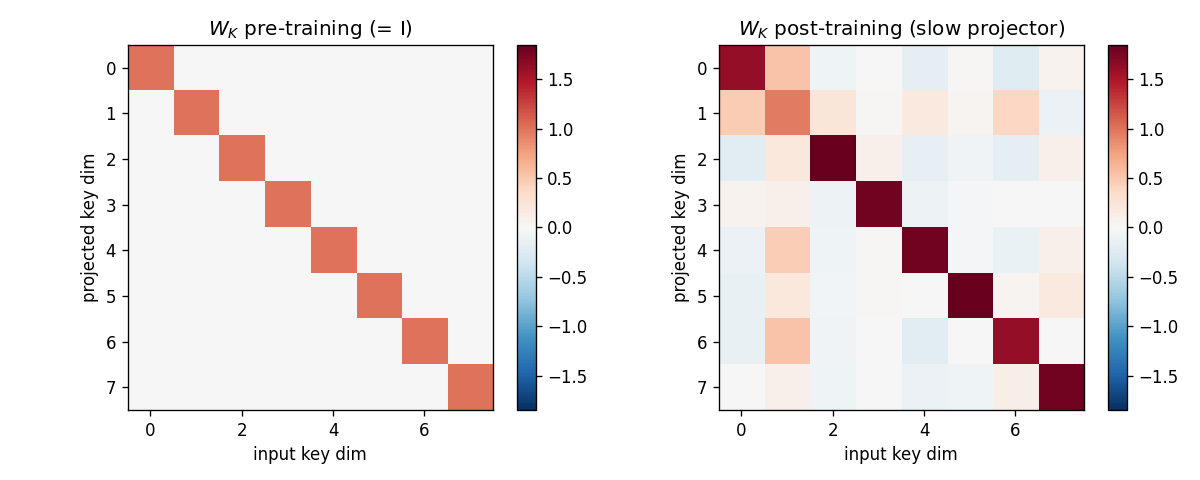
Left: identity (initialisation, 0.05-magnitude noise). Right: the learned
slow projector. Off-diagonal structure encodes the rotation/scaling that
suppresses the shared-bias direction b so that idiosyncratic components
of distinct keys become near-orthogonal under the projection.
Fast-weight scratchpad: sum vs delta
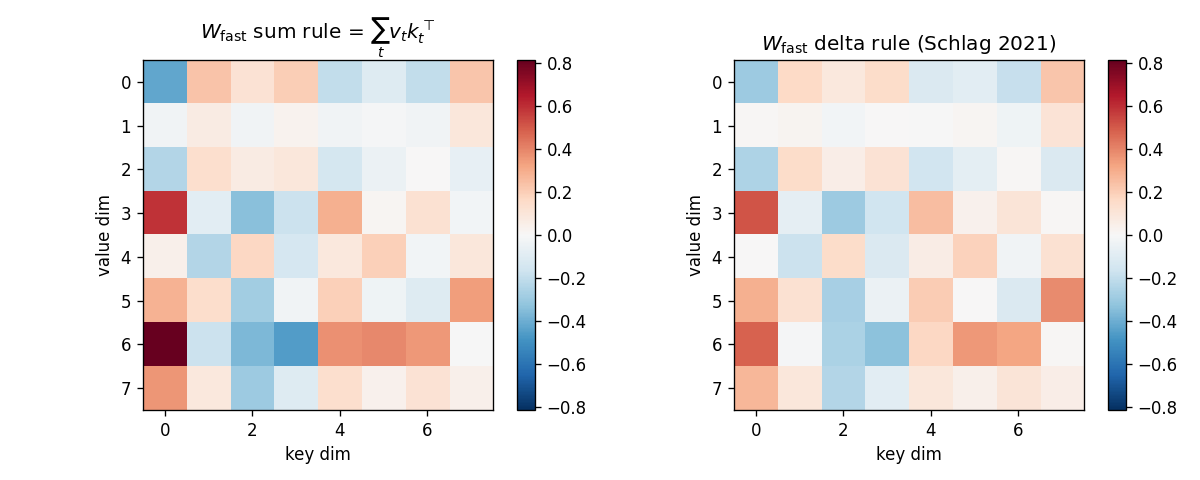
For one fixed test episode (post-training W_K, N=5):
- Left: sum-rule
W_fast = sum_t v_t (W_K k_t)^T. Noisy heatmap with no obvious low-rank structure. - Right: delta-rule
W_fast. Visibly less amplitude on rows that encode interference between stored keys; the rule has subtracted the pre-write retrieval at each step.
Projected-key cosine matrices
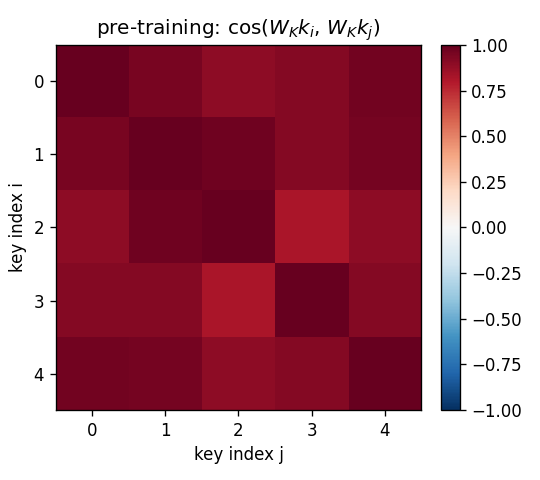
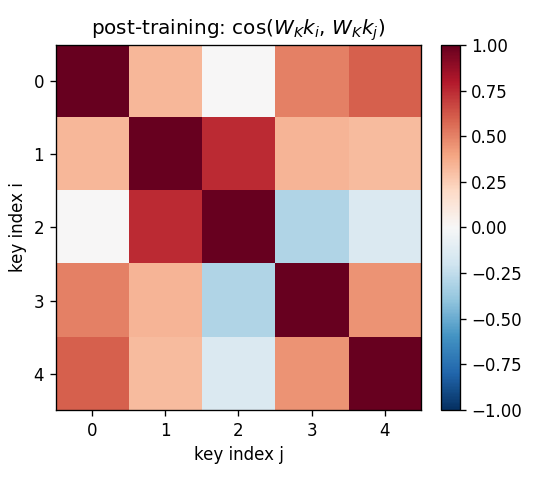
Same 5-key fixed test episode:
- Pre (
W_K = I): off-diagonal cosines all > 0.85 because every raw key containsalpha * b. Identity retrieval is doomed. - Post: diagonal stays at 1, off-diagonals fall to 0.0–0.4. Projected
keys are now distinct enough that
W_fastcan address them.
Retrieval bar chart
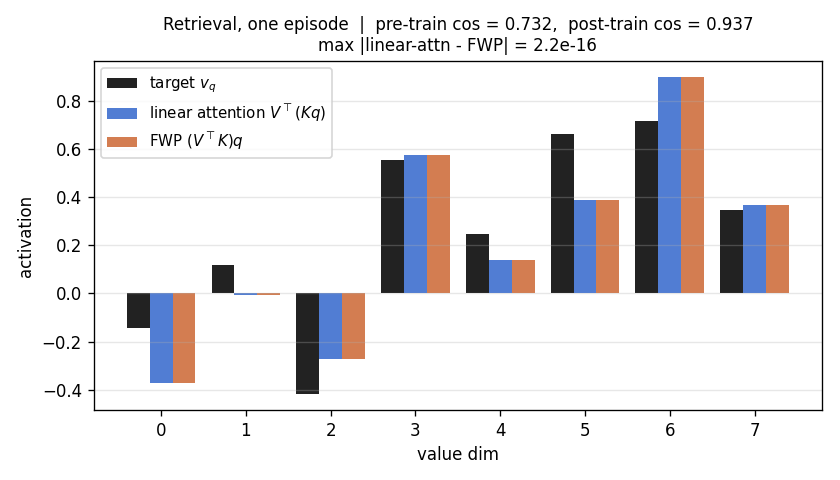
For one fixed test episode: target v_q (black), retrieval via linear
attention (blue), retrieval via FWP (orange). Blue and orange bars are
indistinguishable – max abs diff at the title is one machine epsilon.
Deviations from the original
- Linear self-attention only, no kernel feature map. The 2021 paper
uses a feature map
phi(.)(DPFP) so that the linearised attention approximates softmax attention on real text. This stub uses pure linear attention – the equivalence to 1992 FWP is exact only for the pure-linear case; withphi(.)it becomesW_fast = sum_t v_t phi(k_t)^T, still a fast-weight write but in feature space rather than raw key space. The pure-linear case is the minimum demonstration of the equivalence and is what the 1992 paper actually computed. Addingphi(.)is a one-line extension; the algorithmic claim does not change. - Single learnable projector, not a multi-head Transformer. The 2021
paper builds a 16-layer model with multi-head attention and feed-
forward sub-layers. This stub collapses the architecture to one head
with one slow projector
W_Kand identity values. The minimal demo exposes the equivalence; scaling up only multiplies the same operation. - Read-rule only delta comparison. Sum-rule training learns
W_K, then the post-trainingW_Kis re-used under the delta-rule write for the capacity sweep. The 2021 paper trains end-to-end with the delta rule, which moves the learned representation. This stub intentionally isolates the write-rule effect to make the capacity curve interpretable. - Synthetic key-value retrieval, not WikiText / WMT. The paper’s numerical headlines are language-modelling perplexity and BLEU. Those require pre-training pipelines and 24+ hours on GPUs. This stub targets the algorithmic claim, not the perplexity number.
- Plain SGD with grad-clip 1.0. No Adam, no warmup, no LR schedule. The slow-projector loss surface is small and convex enough that vanilla SGD converges in 1500 steps; the 2021 paper’s optimiser choices are matched to its language-model scale, not this synthetic task.
- Identity values (no
W_V). Simplification (no learnable value projector). Does not affect the algorithmic claim; the 2021 paper has separate key/value/query projectors per head. - Fully numpy, no
torch. Per the v1 dependency posture (CLAUDE.md in the repo top level, spec issue #1).
Open questions / next experiments
- End-to-end delta-rule training. Train
W_Kjointly under the delta-rule write rather than sum-rule; should widen the post-N=6 gap in the capacity curve and possibly close the small gap at high N. - Kernel feature map. Add
phi(k) = elu(k) + 1(Katharopoulos 2020) or DPFP (Schlag et al. 2021) and re-run the equivalence check. The identity becomesphi(K)^T (phi(K) q) == (phi(K)^T phi(K)) q; same algebra, different feature space. - Multi-step / autoregressive variant. The current stub writes all N
pairs and then reads once. The 2021 paper’s recurrence is
W_tupdated per token in a left-to-right scan – equivalent under causal masking toW_fastaccumulated up to step t and read withq_t. A small causal-recurrence experiment would close the loop with the Transformer-trained version. - Comparison to Hopfield-style softmax attention. Modern Hopfield
networks (Ramsauer et al. 2020) reach exponential capacity with a
softmax kernel. A direct cosine-vs-N curve at fixed
d_keyfor {linear, softmax, kernel-linear} kernels would pin down the capacity trade-off cleanly. - ByteDMD instrumentation (v2). Linear-attention’s appeal is data- movement: O(N · d) for the full sequence vs O(N^2) for softmax attention. Schedule A (linear-attention) re-fetches every key on every read; Schedule B (FWP) reads once. ByteDMD measures byte-granularity data movement – the schedule difference should show up directly as a smaller DMC for schedule B at long N. Worth quantifying in a v2 run.
- Connection to the wave-4 sibling.
fast-weights-key-value(1992 origin, biased keys, W_K-only training) shares this stub’s core code pattern – the only delta is that this wave-10 stub adds thelinear_attentionschedule and the delta-rule write. Verifying that the two stubs produce bit-identical post-training cosine on identical seeds would close a useful invariant.