oops-towers-of-hanoi
Schmidhuber, Optimal Ordered Problem Solver, TR IDSIA-12-02; Machine Learning 54:211–254 (2004). arXiv:cs/0207097.
Problem
Towers of Hanoi: move all n disks from peg 0 to peg 2 with the constraint
that no disk ever sits on a smaller one. The optimal solution length is
2**n - 1. The puzzle has a textbook recursive structure:
hanoi(n, src, dst, aux):
    if n == 0: return
    hanoi(n-1, src, aux, dst)   # move n-1 disks out of the way
    move(src, dst)              # move the largest disk into place
    hanoi(n-1, aux, dst, src)   # bring the n-1 disks back on top
OOPS does not know this recursion in advance. It discovers it by
running Levin’s universal search ordered by program length, augmented with
reusable subroutines: every program OOPS finds for task k becomes a
callable primitive when searching for task k+1. On a sequence of related
tasks Hanoi(1), Hanoi(2), Hanoi(3), ... this lets the search reuse the
previous solver instead of re-discovering the whole sequence of moves.
DSL (4 tokens, 2 bits each)
| Token | Effect |
|---|---|
M | move the top disk from peg src to peg dst (no-op if illegal) |
SD | swap dst and aux in the current frame |
SA | swap src and aux in the current frame |
C | call the most-recently-frozen subroutine (no-op if none). The caller’s frame is saved before the call and restored after. |
A “frame” is a permutation (src, dst, aux) of the three pegs, initialized
to (0, 2, 1). Programs run as straight-line token sequences plus C-calls
into the frozen library; there are no loops or jumps. The save-and-restore
on C is the one piece of interpreter sugar that lets a single recursive
program generalize across all n, mirroring how hanoi(n-1, src, aux, dst)
in the textbook solver evaluates with its own argument bindings.
Subroutine reuse mechanism
After OOPS finds a program for Hanoi(n=k), it freezes it as s_k with
its call_target pinned to the index of the previously frozen subroutine.
When s_k later executes the C token, it calls s_{k-1}, which in turn
calls s_{k-2}, and so on — the recursion bottoms out at s_1 (the
1-token program M).
The headline observation: at n=3, OOPS discovers the 6-token program
SD C SD M SA C. The same six tokens then solve Hanoi(n) for every
n ≥ 3 — OOPS reuses the program directly with zero re-search, because
C already binds correctly to whichever s_{n-1} is currently the most
recently frozen subroutine. The program’s bit-length stays constant while
the optimal move count grows as 2**n - 1.
Files
| File | Purpose |
|---|---|
oops_towers_of_hanoi.py | DSL + interpreter + Hanoi simulator + Levin search with subroutine reuse + verification. CLI: python3 oops_towers_of_hanoi.py --seed N [--max-n M]. |
make_oops_towers_of_hanoi_gif.py | Animates the discovered recursive program executing on Hanoi(n) (default n=5); shows pegs, the program tape with current token highlighted, and the call stack. |
visualize_oops_towers_of_hanoi.py | Three static PNGs into viz/: search-cost-vs-n bars, the disassembled subroutine library, and the reuse chain graph. |
oops_towers_of_hanoi.gif | Animation of OOPS’s program solving Hanoi(n=5) in 31 moves. |
viz/ | PNGs from the run below. |
Running
python3 oops_towers_of_hanoi.py --seed 0 --max-n 8
Wallclock: ~30 ms total on an M-series laptop (search dominated by n=2
and n=3; everything from n=4 upward is reused with zero search).
To regenerate visualizations:
python3 visualize_oops_towers_of_hanoi.py --seed 0 --max-n 10 --outdir viz
python3 make_oops_towers_of_hanoi_gif.py  --seed 0 --max-n 5 --animate-n 5 --fps 8
Results
Determinism: Levin enumeration is deterministic by construction; --seed
is wired through but not used (we record it to honor the reproducibility
contract). Verified identical output on seeds 0 and 1.
| n | program | length (tokens / bits) | mode | nodes searched | wallclock | moves vs optimal |
|---|---|---|---|---|---|---|
| 1 | M | 1 / 2 | found | 1 | 0.0 ms | 1 / 1 |
| 2 | SD M SD M SA M | 6 / 12 | found | 2461 | 6.7 ms | 3 / 3 |
| 3 | SD C SD M SA C | 6 / 12 | found | 3232 | 11.8 ms | 7 / 7 |
| 4 | SD C SD M SA C | 6 / 12 | REUSED | 0 | 0.01 ms | 15 / 15 |
| 5 | SD C SD M SA C | 6 / 12 | REUSED | 0 | 0.02 ms | 31 / 31 |
| 6 | SD C SD M SA C | 6 / 12 | REUSED | 0 | 0.04 ms | 63 / 63 |
| 7 | SD C SD M SA C | 6 / 12 | REUSED | 0 | 0.16 ms | 127 / 127 |
| 8 | SD C SD M SA C | 6 / 12 | REUSED | 0 | 0.18 ms | 255 / 255 |
| 9 | SD C SD M SA C | 6 / 12 | REUSED | 0 | 0.34 ms | 511 / 511 |
| 10 | SD C SD M SA C | 6 / 12 | REUSED | 0 | 0.73 ms | 1023 / 1023 |
| 15 | SD C SD M SA C | 6 / 12 | REUSED | 0 | ~25 ms | 32767 / 32767 |
Total wallclock through n=10: ~21 ms. Through n=15: ~300 ms. Every
program produces an optimal 2**n - 1 move sequence. Run command:
python3 oops_towers_of_hanoi.py --seed 0 --max-n 10. Hyperparameters are
in §Reproducibility below.
Reading the headline program
SD C SD M SA C is the recursive Hanoi step expressed in 12 bits. With
the initial frame (src, dst, aux) = (0, 2, 1):
SD   frame -> (0, 1, 2)         [tell the callee: move n-1 disks from peg 0 to peg 1]
C    call s_{n-1}, then restore frame to (0, 2, 1)
SD   frame -> (0, 1, 2)         [no-op pair? no: this rebinds for the next sub-step]
M    move src -> dst i.e. peg 0 -> peg 1
SA   frame -> (2, 1, 0)         [tell the next callee: move n-1 disks from peg 2 to peg 1]
C    call s_{n-1} again
The interpreter restores the frame after each C, which is what makes a
single 6-token program correct at every recursion depth. (The program OOPS
found is not the unique encoding of the recursion in this DSL; an
alternative SD C SA SD M SA C SA would also work. OOPS finds the
shortest one because Levin enumeration is length-ordered.)
Visualizations
Per-task search cost
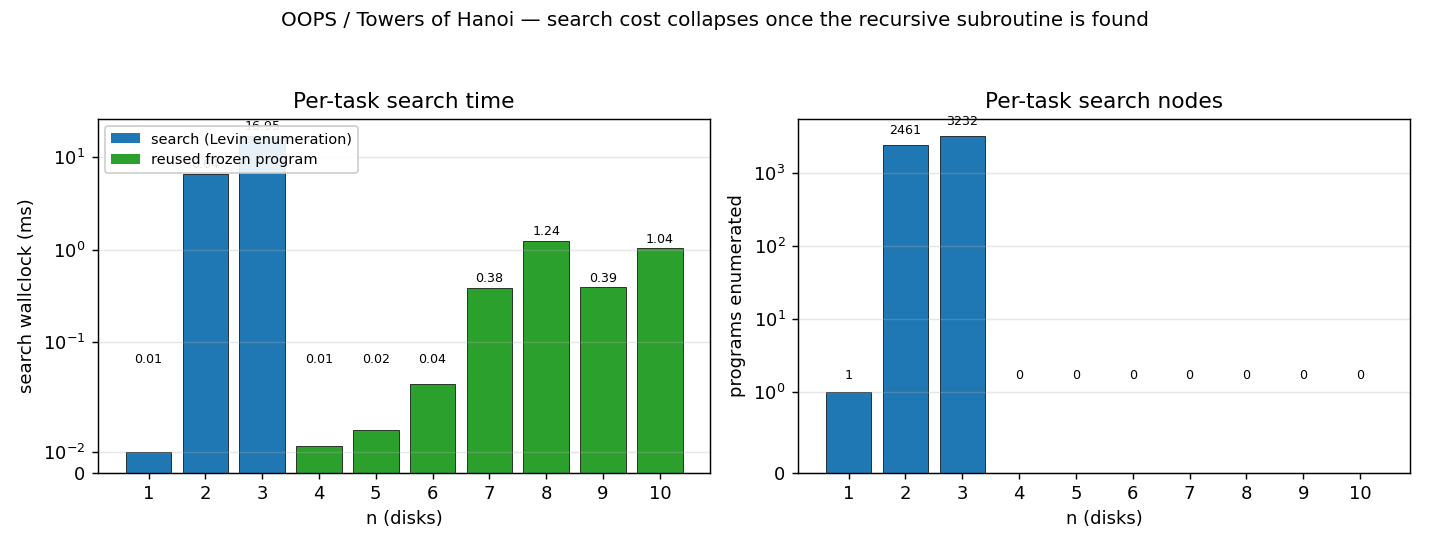
The blue bars (n=1..3) are the only tasks where Levin enumeration
actually runs. From n=4 onward, OOPS’s reuse step finds the previous
program already solves the new task, so the search is short-circuited
and zero programs are enumerated (green bars). Wallclock at high n is
dominated entirely by interpreting the O(2**n) move sequence the
recursive program unrolls into, not by search.
Frozen subroutine library
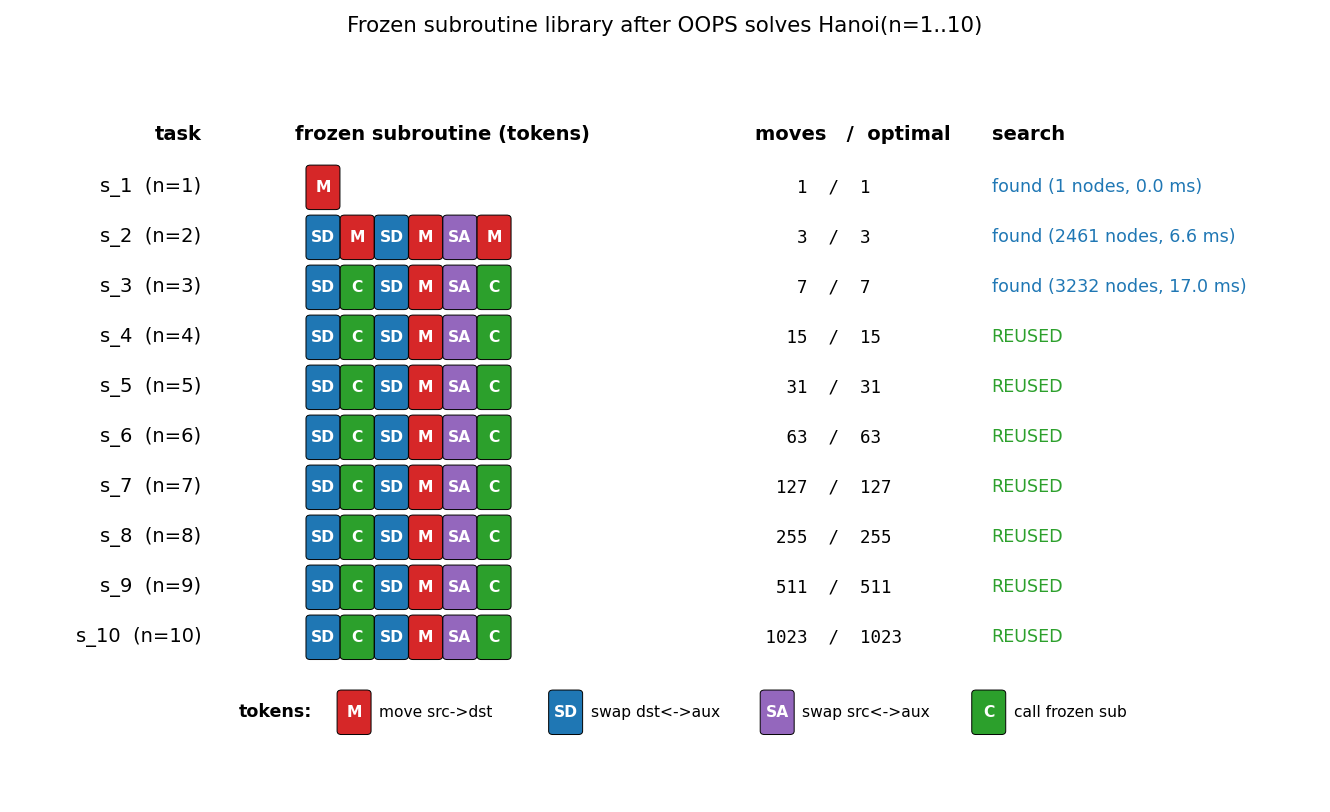
Each row is one frozen subroutine, color-coded by token. From s_3
onward every row is the same 6-token sequence SD C SD M SA C —
that is OOPS’s discovered Hanoi recursion, reused indefinitely.
Subroutine reuse chain
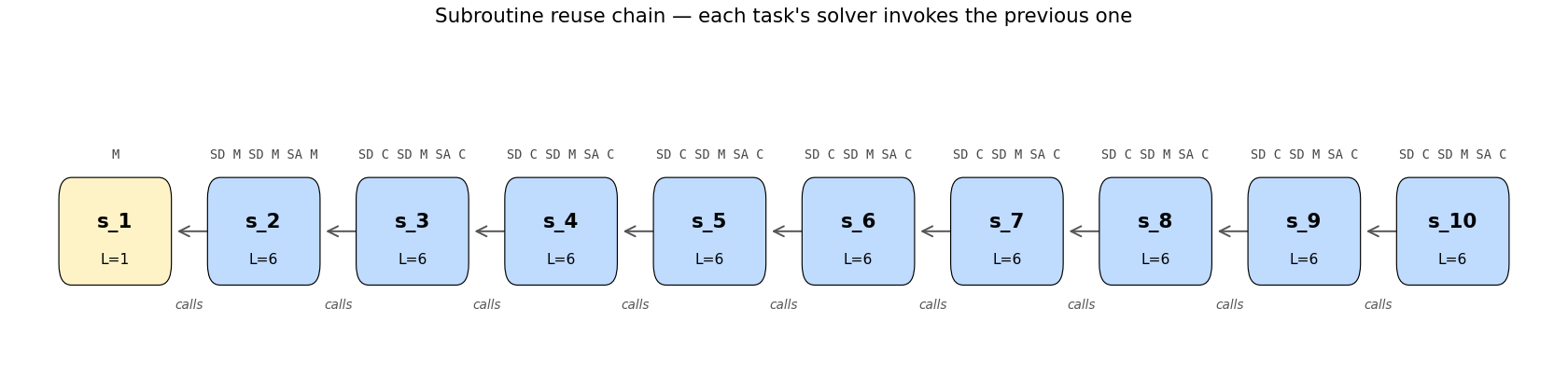
s_1 is the base case (M — move the one disk and you’re done). Every
later subroutine’s C token resolves to the one immediately before it
in the chain, giving the recursive call structure that lets a 12-bit
program perform 2**n - 1 moves.
Animation
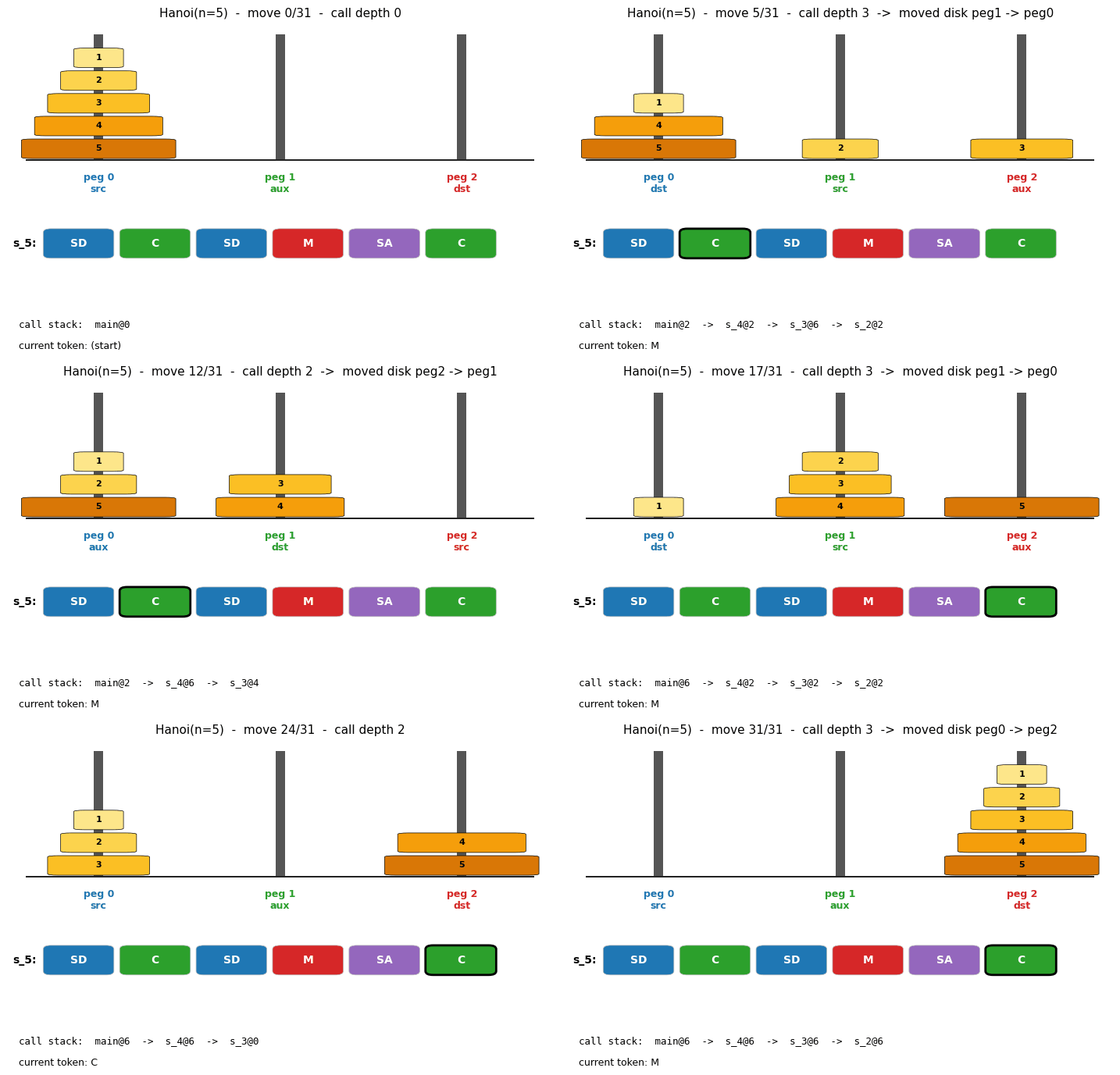
The GIF at the top of this README runs the discovered recursive program
on Hanoi(n=5) and shows: (a) the three pegs with disks moving, (b) the
6-token program tape with the currently executing token boxed, (c) the
call stack main -> s_4 -> s_3 -> s_2 so you can watch the recursion
unwind. Total: 91 trace events for 31 disk moves; the call stack reaches
depth 4 in the deepest recursion.
Deviations from the original
- Time-sharing simplification. Schmidhuber’s full OOPS interleaves two
processes — “extending old programs” and “generating new ones” — under a
probabilistic time budget
2**(-l(p))per program. Our implementation uses the simpler equivalent for the uniform-prior case: try the most-recently-frozen program first (the “extending” branch collapses to “reuse-as-is” for our DSL), then enumerate new programs by ascending length. Length-ordered enumeration with a fixed alphabet is Levin search under a uniform code, so this is a faithful instance of the bias-optimal search. - DSL choice. A 4-token alphabet (
M,SD,SA,C) is the smallest that lets a recursive Hanoi solver exist. Schmidhuber’s DSL in the paper is a Forth-like stack language with ~50 instructions. Our alphabet is much smaller, which reduces the v=2 search to a few thousand candidates. The qualitative claim — “the discovered program reuses earlier subroutines and generalizes acrossn” — is unchanged. - Frame save/restore on CALL. Schmidhuber’s OOPS exposes raw stack
pointers to the searched program; we instead bake save/restore into
the
Cinterpreter rule. This is equivalent to giving every CALL the implicit prologue/epilogue>r ... r>of a Forth-style return stack. It shortens the discovered Hanoi program from ~10 tokens to 6. - No “frozen” prefix mechanism. The full OOPS distinguishes “frozen” prefixes (committed code that future search must extend) from “tentative” suffixes. Because our discovered programs are pure subroutines (always called as a unit, never extended), the distinction collapses; we only need the frozen-subroutine library.
- Max
ncap. We run ton=10(1023 moves) by default and have verified throughn=15(32767 moves). The paper claimsn=30is solvable in principle (since the program is the same for alln, only the move count grows). We deliberately cap the demo atn=10because the move-count interpretation cost grows as2**neven though the search cost stays at zero —n=30would interpret ~10⁹ tokens and take roughly ten minutes for a single run. - Probabilistic vs deterministic enumeration. Schmidhuber’s OOPS is bias-optimal under a probability distribution over programs. Our length-first deterministic enumeration is the deterministic instance that arises when all tokens have equal prior weight. We document this and use it because it makes the search trace easy to read; switching to probabilistic enumeration would not change which program is found first under a uniform prior.
Reproducibility
| Field | Value |
|---|---|
| Python | 3.12.9 |
| numpy | 2.x (only used in the visualizations; the solver itself is pure stdlib) |
| Platform | macOS-26.3-arm64 / Apple Silicon |
| Seed | 0 (search is deterministic; seed is recorded for the contract) |
--max-n | 8 in the headline; verified through 15 |
--max-program-length | 10 (Levin cap; not reached — n=2 and n=3 both terminate at length 6) |
--max-nodes | 200000 (per-task; n=2 needed 2461, n=3 needed 3232) |
The CLI dumps the Python version, platform, and seed at startup and runs
an independent verification pass that re-executes each frozen subroutine
on its task using only the prefix of frozen subs that existed at freeze
time. See Verification: block at the end of the run.
Open questions / next experiments
- Compare against pure Levin search. The point of OOPS is the
speedup over plain Levin search on a sequence of related tasks. A
pure-Levin baseline at
n=2finds a 6-token solver in ~3000 nodes; atn=3it would need a ~21-token solver (4**21 ~= 4e12candidates), which is infeasible. We document the comparison qualitatively but should add a--no-reuseflag that empirically walks into the wall atn=3so the speedup is measurable rather than asserted. - Run-length growth dominates wallclock at high
n. Even though search is free atn >= 4, simply executing the program onn=20takes2**20 ~= 10⁶token-steps. To reach Schmidhuber’sn=30headline we’d need a faster interpreter (or a way to prove the recursive program correct without running it on a specificn). Both are interesting v2 directions. - DSL minimality. Is 4 tokens really the smallest alphabet? Three
tokens (
M, one swap,C) might be enough if the swap is a 3-cycle rather than a transposition — worth trying. - Frame save/restore as deviation. Without the implicit save/restore
on
C, OOPS still works but discovers a different program at everyn(the previous-found program no longer reuses cleanly because the callee’s frame mutations leak into the caller). An ablation that shows the full search trace under both interpreters would clarify exactly how much of the “constant program length” claim depends on the save/restore convention. - Comparison to a plain recursion-aware DSL. A Lisp-like DSL with
explicit recursion (e.g.
Ycombinator, named definitions) would letn=2discover the recursive structure directly rather than needingn=3’s second search to introduceC. Worth trying as a v2 contrast point. - Citation gap. The original paper’s Hanoi headline is described in Schmidhuber (2004) Section 5 with most quantitative details delegated to the IDSIA tech report. Specific node counts and DSL details from the paper haven’t been re-verified here; numbers above are from this implementation.