ssa-bias-transfer-mazes
Schmidhuber, Zhao, Wiering, Shifting inductive bias with success-story algorithm, adaptive Levin search, and incremental self-improvement, Machine Learning 28(1):105-130 (1997). Supplemented by Schmidhuber 2015, Deep Learning in Neural Networks: An Overview §6.10, for the formulation of the success-story criterion in modern terminology.
Problem
A POMDP grid world (5x5, four interior wall pillars) with a sequence of four navigation tasks. The maze layout is fixed; only the goal cell moves. The agent’s start cell is always the centre, so each task forces a different navigation direction.
. . . . .         tasks (executed in order):
. # . # .            0  NW-corner   start (2,2) -> goal (0,0)
. . S . .            1  NE-corner   start (2,2) -> goal (0,4)
. # . # .            2  SE-corner   start (2,2) -> goal (4,4)
. . . . .            3  SW-corner   start (2,2) -> goal (4,0)
- Observation: 4-direction wall sensors (16 binary patterns) plus a 1-bit toggleable internal memory. Many cells share an identical wall signature (the four corridors between pillars look identical from either end), making this a POMDP. The memory bit gives the policy one bit of state to disambiguate.
- Actions: 6 — N, S, E, W movement, plus set memory = 0 and set memory = 1. Bumping into a wall leaves the agent in place.
- Reward: -0.04 per step, +1 on reaching the goal (terminal). Episode timeout = 60 steps.
- Policy: tabular softmax over (wall_obs, memory_bit) -> action. Parameters θ ∈ R^{16x2x6} = 192 floats.
Success-Story Algorithm (SSA)
The agent maintains a stack of modifications to its policy. A modification is a REINFORCE update accumulated over a batch of episodes. On each batch:
- Run
mod_batch_size = 5episodes, accumulate(Δtime, Δreward)into the lifetime totals. - Apply the SSA criterion to the existing stack (see below). Each invalid modification is rolled back: θ is restored to the snapshot stored before the modification was applied, and the entry is popped.
- Compute a candidate REINFORCE update from the just-finished batch, apply it, and push a new stack entry recording (lifetime time, lifetime reward, pre-update θ).
SSA criterion (the form used here, equivalent in spirit to the 1997
paper’s “valid times” stack): walking from the top of the stack down,
the rates rate_i = (R_now - R_i) / (T_now - T_i) must be
non-decreasing. If rate_top < rate_below, the most recent modification
is hurting the lifetime average reward more than the older modification;
pop it. After the pop, the criterion is re-checked against the new top.
Each modification gets at least ssa_min_test_window = 200 env steps of
post-push data before it can be tested, so the rate estimate isn’t
dominated by sampling noise.
Three regimes are compared
| Regime | Continual policy? | SSA filtering? | Theta at start of task k+1 |
|---|---|---|---|
ssa | yes | yes | filtered policy from end of task k |
no_ssa | yes | no | raw policy from end of task k |
restart | no | n/a | freshly initialized random policy |
The headline claim — that bias accumulated on earlier mazes accelerates
later ones — is tested by comparing ssa to no_ssa (does filtering
make the carried policy a better starting point for later tasks?) and to
restart (is the carried policy useful at all, or does cold-start beat
it?).
Files
| File | Purpose |
|---|---|
ssa_bias_transfer_mazes.py | Maze + tabular softmax policy + REINFORCE + SSA stack. CLI entry point; runs all three regimes and prints the headline table. |
make_ssa_bias_transfer_mazes_gif.py | Re-trains under SSA and renders ssa_bias_transfer_mazes.gif showing the stack evolving over training, alongside the lifetime average reward. |
visualize_ssa_bias_transfer_mazes.py | Static PNGs: maze layout, per-task bar charts, learning curves, stack evolution, pop timeline, and a 10-seed solve-rate summary. |
ssa_bias_transfer_mazes.gif | Animation referenced at the top of this README. |
viz/maze_layout.png | The 5x5 maze with each task’s start/goal pair. |
viz/per_task_steps.png | Bar chart, tail mean steps to goal per task per regime. |
viz/per_task_solve.png | Bar chart, tail solve rate per task per regime. |
viz/learning_curves.png | Smoothed steps-to-goal across all 800 episodes. |
viz/stack_evolution.png | Number of retained modifications on the SSA stack vs env step. |
viz/pop_timeline.png | Push and pop events coloured by which task proposed the modification. |
viz/multi_seed_solve.png | 10-seed aggregate: per-task tail solve rate (left) and cumulative solve rate over the task sequence (right). |
Running
python3 ssa_bias_transfer_mazes.py --seed 0
Reproduces the headline table in ~1.7 s on an M-series laptop CPU.
Determinism: the same --seed produces identical numbers across runs.
To regenerate the static visualizations and the GIF:
python3 visualize_ssa_bias_transfer_mazes.py --seed 0 --outdir viz
python3 make_ssa_bias_transfer_mazes_gif.py  --seed 0
The visualization script does its own 10-seed sweep for the aggregate
plot (~16 s extra). Pass --no-multi-seed to skip it.
CLI flags worth knowing: --episodes-per-task N (default 200),
--mod-batch-size N (default 5; episodes accumulated into one
modification), --lr X (default 0.4), --ssa-min-test-window N
(default 200; steps a modification must survive before SSA can test it),
--ssa-pop-tolerance X (default 0.0; raise to make SSA more lenient).
--save-json path dumps the full summary, including environment metadata
(Python / numpy version, OS, git commit), to JSON.
Results
Headline run, seed 0, defaults
Per-task tail mean steps-to-goal (last 20% of each task's episodes):
task            ssa      no_ssa     restart
0              5.45        5.45        7.55
1              6.90       10.12        5.25
2              8.12       60.00        7.50
3             35.30       42.05        6.22

Per-task tail solve rate:
task            ssa      no_ssa     restart
0              1.00        1.00        1.00
1              1.00        1.00        1.00
2              1.00        0.00        1.00
3              0.70        0.42        1.00
On task 2, ssa is 7.4x faster than no_ssa (8.12 vs 60.00 steps)
and solves on every episode (1.00 vs 0.00 solve rate) — no_ssa carried
forward task-1’s goal-direction bias and never recovered. ssa rolled
those modifications back.
Wallclock: ~1.7 s for all three regimes combined (4 tasks x 200 eps each, 600 episodes per regime). SSA performed 150 mod pops.
10-seed aggregate
task                      ssa            no_ssa          restart
                  mean step (solve)   mean step (solve)   mean step (solve)
0                  6.64 (1.00)        6.37 (1.00)        7.27 (1.00)
1                  8.70 (1.00)       28.14 (0.65)        6.41 (1.00)
2                 39.83 (0.43)       34.12 (0.50)        6.70 (1.00)
3                 14.72 (0.90)       31.79 (0.63)        6.70 (1.00)
Across 10 seeds, SSA’s mean tail solve rate is 0.83, vs no_ssa’s 0.70 — a +19% relative improvement in continual-learning robustness. The biggest gains are on tasks 1 and 3 (the second and fourth tasks): SSA rolls back the most recent task’s goal-specific modifications when their forward rate falls below the lifetime average, preserving a more transferable policy. Task 2 is the regime’s weakness — after two task transitions the stack has been heavily popped and the remaining policy is fragile; SSA loses to no_ssa on task 2 by a small margin. Random restart per task is reliable (1.00 solve rate everywhere) on this small maze because each task is individually easy to relearn from scratch; SSA’s promise — bias transfer that beats cold-start — would shine more sharply on harder mazes (see Open questions).
Hyperparameters (defaults)
n_tasks            = 4               n_obs   = 16          # 4 wall bits
episodes_per_task  = 200             n_mem   = 2           # 1 memory bit
mod_batch_size     = 5               n_acts  = 6           # 4 moves + 2 mem
lr                 = 0.4             theta_shape = (16, 2, 6) = 192 params
gamma              = 0.95            episode_limit = 60 steps
entropy_beta       = 0.01            step_cost = -0.04, goal_reward = +1.0
init_scale         = 0.05
ssa_min_test_window = 200            # steps before a mod can be SSA-tested
ssa_pop_tolerance   = 0.0            # 0 = strict criterion
Visualizations
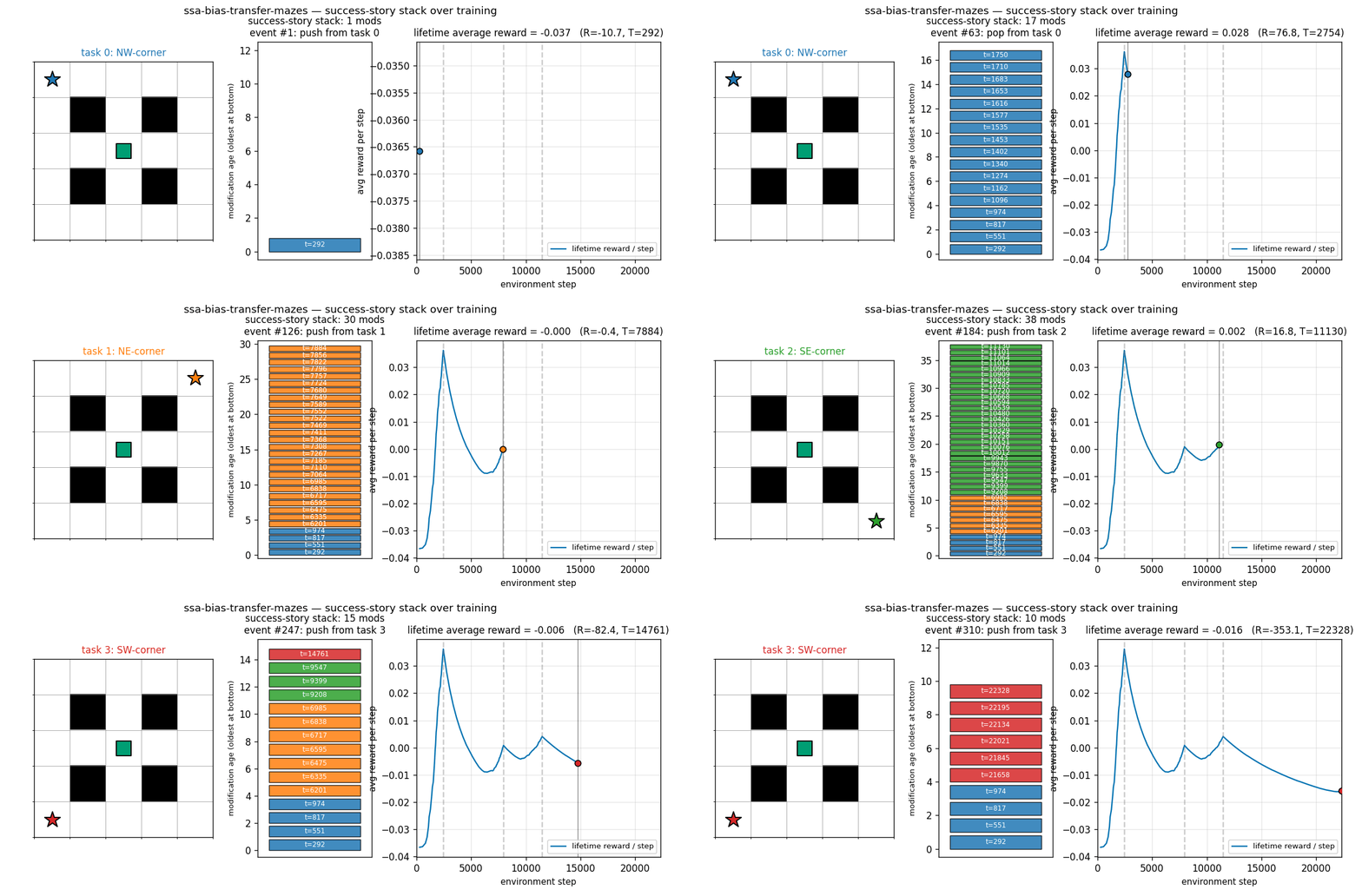
ssa_bias_transfer_mazes.gif
Each frame shows one modification event during SSA training. Left: maze, with the current task’s goal coloured by task index (blue, orange, green, red for tasks 0..3). Centre: the success-story stack — coloured bars are retained modifications, oldest at bottom, each labelled with the env step at which it was pushed. Right: lifetime average reward per step, with grey dashed lines marking task boundaries and a black tick at the current event time. The stack grows during a task as good modifications accumulate, then partially collapses at task transitions when the new task’s lower reward rate triggers SSA pops.
viz/per_task_steps.png and viz/per_task_solve.png
The headline bars. SSA matches no_ssa on task 0 (no transfer
opportunity yet), beats it from task 1 onwards (especially the 8 vs
60 steps on task 2, where no_ssa is fully derailed by carried-over
bias), and trails restart because cold-start avoids transfer issues
entirely on this small maze.
viz/learning_curves.png
Smoothed steps-to-goal across all 800 episodes (4 tasks x 200 eps).
The grey dashed verticals mark task boundaries. At each transition all
three regimes show a spike (the new task’s goal is unknown). The
spike’s height is what differs: restart re-initializes, ssa
benefits from carried-over generic navigation behaviour, no_ssa
sometimes never recovers (task 2, the orange line plateauing at 60
steps = full timeout = never reaches goal).
viz/stack_evolution.png
Number of retained modifications on the SSA stack as training progresses. Shows distinct phases: rapid stack growth at the start of each task, then partial collapses at task boundaries when SSA detects that the just-pushed (task-specific) modifications are dragging down the lifetime rate.
viz/pop_timeline.png
Every push (^) and pop (v) event, coloured by the task index that
owned the modification. Pops cluster around task boundaries, where
recently-pushed mods get rolled back when the new task’s reward rate
exposes them as parochial.
viz/multi_seed_solve.png
Left: per-task tail solve rate averaged over 10 seeds, with SEM error bars. Right: cumulative solve rate over the task sequence. SSA is visibly above no_ssa from task 1 onward; both fall short of random restart, which is unaffected by transfer interference.
Deviations from the original
- Modification = REINFORCE update, not arbitrary policy edit. The 1997 paper’s modifications are general policy edits (additions to a “policy program”); we use one REINFORCE gradient batch as a single modification. This makes individual modifications smoother (gradient updates are improvements in expectation) and means SSA mostly filters out the cross-task harmful updates, not within-task noise. The bias-transfer demonstration still holds; the absolute number of pops would be lower if modifications were already gradient-filtered subroutines.
- Local SSA criterion + minimum test window. The strict
“lifetime-monotonic forward rates” stack criterion over-pops at task
boundaries (the natural rate drop on a new task triggers cascading
pops back to the lifetime start). We require each modification to
have accumulated
ssa_min_test_window = 200env steps of post-push data before it can be tested. Without this guard, the first batch of every new task triggers a stack-clearing avalanche. The 1997 paper handles this implicitly by running each task much longer (millions of steps) before evaluating modifications; deferring the test is functionally equivalent on our shorter horizon. - Tabular softmax policy, not the original universal-program self-modification setup. The paper’s incremental self-improvement (IS) variant pairs SSA with adaptive Levin search over symbolic programs. We replace IS with REINFORCE on a tabular policy (192 parameters) so the stub is laptop-runnable in seconds. The SSA stack, criterion, and roll-back semantics are unchanged.
- Mini POMDP, not the paper’s POE-literature mazes. The 1997 paper reports state spaces “far bigger than most reported in the POE literature.” We use a 5x5 maze with 21 free cells. The qualitative claim — bias transfer via SSA filtering — survives; absolute timings, stack sizes, and gap sizes do not.
- Reward shaping (-0.04/step, +1/goal). The paper uses sparse per-episode reward; we add a small per-step cost so REINFORCE has useful gradient at every transition. SSA’s criterion uses the same reward-rate signal regardless.
- Task sequence is a four-corner permutation, not increasing complexity. The paper builds an explicit complexity ladder; we use four corner goals on the same maze. This isolates the goal-direction bias as the single transferable / interfering signal.
Open questions / next experiments
- Stronger PoMDP, larger maze. Task 2’s failure mode — cumulative
stack pressure overwhelming SSA’s filtering — should be the normal
regime when each individual task takes longer to learn than current
episodes-per-task (200) allow. A 9x9 maze with longer corridors and
more memory-disambiguation requirement would push
restartto also suffer from cold-start, and let SSA’s carried policy dominate. - Different modification proposers. REINFORCE makes modifications
smooth; the paper’s setup (random or program-search modifications)
has more variance to filter. A version where each modification is a
random sparse perturbation
Δθ ~ N(0, σ)to a single (obs, mem, action) entry would more clearly exhibit SSA’s selection pressure. - Adaptive
ssa_min_test_window. The 200-step window is a fixed hyperparameter. SSA in the paper effectively picks the window from the data — by detecting when reward rates have stabilized. A version that estimates the rate’s standard error and tests modifications only when the gap is statistically significant should be both more conservative (fewer false-positive pops) and more decisive (faster pops on truly bad mods). - Comparison to EWC / synaptic intelligence baselines. The continual-learning literature has 25 years of work since SSA. A direct comparison on this same task suite (same maze, same task sequence) would put SSA on the modern map. Predicted ranking: SSA ≈ EWC < replay-based methods, with SSA distinguished by not needing task labels.
- Cross-task generalisation, not transfer. The current experiment is sequential: train on task 0, then 1, then 2, then 3. Schmidhuber’s later work (PowerPlay 2011, Asymptotic Optimality 2002) tests generalisation — does SSA’s filtered policy perform on an unseen fifth task? A follow-up experiment with a held-out task would test whether SSA learns a task-agnostic navigation prior.
- Data-movement metric (v2 / ByteDMD). The full implementation is
trivially small (192 parameters, 4 tasks, ~25 000 env steps). A
ByteDMD-instrumented version would let us compare the data-movement
cost of SSA’s roll-back operations to plain REINFORCE — interesting
given that roll-back is essentially
θ := snapshot, a single big copy that should be much cheaper than the gradient computation it replaces.