timit-blstm-ctc
Graves & Schmidhuber, Framewise Phoneme Classification with Bidirectional LSTM and Other Neural Network Architectures, Neural Networks 18 (2005); Graves, Fernandez, Gomez, Schmidhuber, Connectionist Temporal Classification: Labelling Unsegmented Sequence Data with Recurrent Neural Networks, ICML 2006.
Problem
The 2005/2006 Graves+Schmidhuber pair makes two coupled claims:
- Bidirectional LSTM (BLSTM) beats unidirectional LSTM on TIMIT framewise phoneme classification, because at any given frame the identity of the current phoneme is influenced by both preceding and following acoustic context.
- CTC removes the need for pre-segmented training data. The network emits a per-frame distribution over labels (plus a special “blank”), and the CTC forward-backward marginalises over every alignment between frames and target labels consistent with the unsegmented target label sequence.
Per SPEC issue #1, this v1 stub uses a pure-numpy synthetic phoneme corpus in place of the original TIMIT speech corpus (which was originally v1.5-deferred for the external dataset). The corpus reproduces the structural property the algorithm exploits: short, locally characteristic acoustic units concatenated into variable-length sequences without frame-level alignment labels. CTC + BLSTM must (a) learn each phoneme’s spectral signature from frame features alone and (b) discover the alignment to the unsegmented label sequence.
Synthetic phoneme corpus
K = 6phonemes plus a CTC blank symbol (index 0).n_features = 8mel-like frequency bands per frame.- Each phoneme has two spectral signatures:
- an early (onset) signature – a single formant band shared with one neighbour phoneme. The first ~45 % of every realisation is dominated by this shared onset, so the start of a phoneme alone is ambiguous between members of an onset cluster.
- a late (distinguishing) signature – 1-2 formant bands that are unique per phoneme, dominating the second half of the realisation.
- Per-band oscillation
cos(omega_kj t + phi_kj)riding on the signature; rising-then-falling amplitude envelope; additive Gaussian noise (sigma = 0.18). - Each phoneme realisation is 4-10 frames long; consecutive phonemes are separated by 2-5 silence frames; sequences contain 3-8 phonemes; total length T ~ 25-90 frames.
This co-articulation structure is what makes the direction of recurrence matter: at the start of a phoneme, “past + present” alone cannot tell some phoneme pairs apart, but “past + present + future” can.
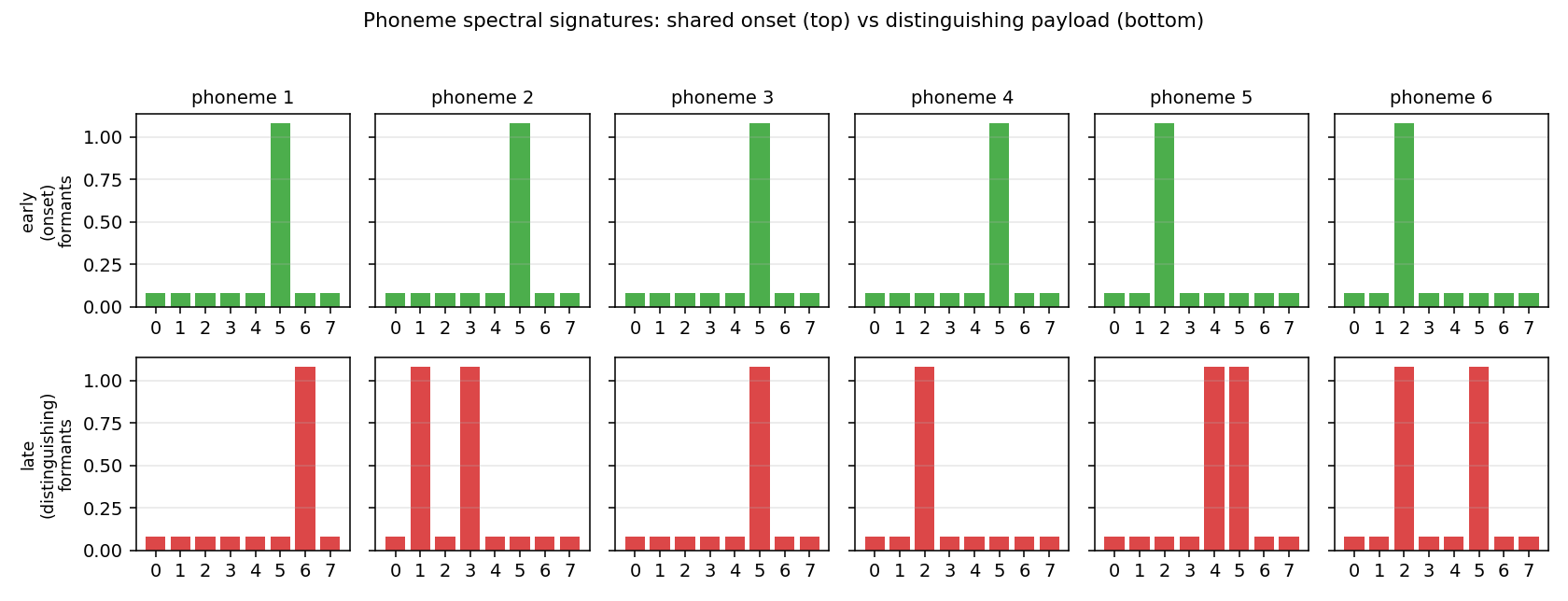 Phoneme spectral signatures. Top row (green) is the shared early
onset; bottom row (red) is the distinguishing late payload. Phonemes
1-4 share onset band 5; phonemes 5-6 share onset band 2.
Phoneme spectral signatures. Top row (green) is the shared early
onset; bottom row (red) is the distinguishing late payload. Phonemes
1-4 share onset band 5; phonemes 5-6 share onset band 2.
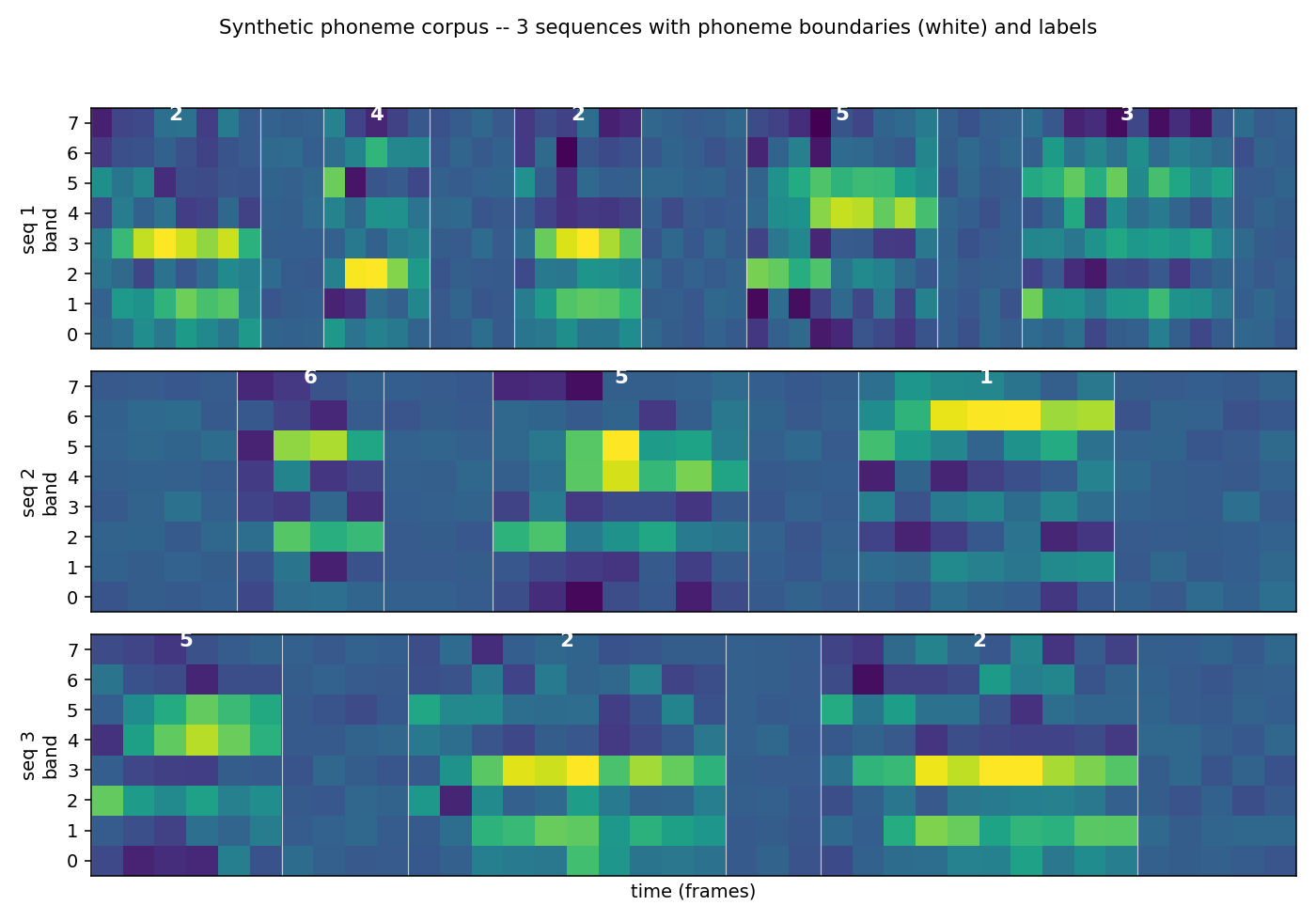 Three example sequences with phoneme boundaries (white) and labels
(white digits). Bands are mel-like; brightness is amplitude.
Three example sequences with phoneme boundaries (white) and labels
(white digits). Bands are mel-like; brightness is amplitude.
Architecture
- BLSTM cell with forget gate (Gers/Schmidhuber/Cummins 2000 variant). Two independent LSTMs run forward and backward over the sequence; their hidden states are concatenated at each time step.
- Linear projection
2H -> K+1followed by softmax over the CTC alphabet (K phoneme labels plus blank). - CTC forward-backward in log-space. Closed-form gradient on the
softmax pre-activation:
dL/da_t,k = y_t,k - (1/P) * sum_{s: l'_s = k} alpha_t(s) beta_t(s). - Manual BPTT through both LSTMs (the backward LSTM’s grads come back along the reversed time axis).
- A unidirectional LSTM baseline of the same hidden size is also trained so the BLSTM advantage is measurable.
Files
| File | Purpose |
|---|---|
timit_blstm_ctc.py | corpus generator, LSTM cell, BLSTM model, CTC forward-backward + closed-form gradient, BPTT, Adam, gradcheck, train + eval + CLI |
visualize_timit_blstm_ctc.py | trains BLSTM + uni-LSTM and writes 5 PNGs to viz/ |
make_timit_blstm_ctc_gif.py | trains BLSTM with frequent snapshots and renders the alignment GIF |
timit_blstm_ctc.gif | GIF at the top of this README (CTC alignment over training) |
viz/corpus_signatures.png | phoneme spectral signatures (early vs late formants) |
viz/corpus_sample.png | 3 sequences with phoneme boundaries |
viz/training_curves.png | NLL + PER + sequence accuracy, BLSTM vs uni-LSTM |
viz/ctc_alignment.png | example CTC posterior aligned to one sequence |
viz/weight_matrices.png | input-to-gate matrices of fwd / bwd LSTM + output projection |
Running
Reproduce the headline BLSTM number:
python3 timit_blstm_ctc.py --seed 0
Wallclock 72.6 s to train + evaluate 1500 iterations at hidden=24, batch=16 on an M-series laptop CPU (Python 3.14, numpy 2.4). PER drops to 0 by iter 300 and stays there.
To verify BPTT + CTC gradients numerically:
python3 timit_blstm_ctc.py --gradcheck
# [blstm] gradcheck: max relative error = 1.12e-07 over 88 samples
# [uni]   gradcheck: max relative error = 2.04e-08 over 52 samples
To run the uni-LSTM baseline:
python3 timit_blstm_ctc.py --seed 0 --uni
To regenerate the 5 PNGs (also trains both models internally):
python3 visualize_timit_blstm_ctc.py
To regenerate the GIF (trains a BLSTM + reference uni-LSTM with extra snapshots):
python3 make_timit_blstm_ctc_gif.py
Results
Headline (5-seed sweep, default hyperparameters)
PER is the phoneme error rate from greedy CTC decoding (collapse
repeats, drop blanks) against the held-out label sequence; iter to solve is the first eval iter at which PER <= 0.05 on a 64-sequence
held-out batch.
| Model | iter to solve (5 seeds) | final PER (5 seeds) | wallclock / seed |
|---|---|---|---|
| BLSTM | 300, 300, 300, 300, 300 (mean 300) | 0.000, 0.000, 0.000, 0.000, 0.000 | ~64 s |
| uni-LSTM | 600, 600, 500, 600, 500 (mean 560) | 0.000, 0.000, 0.000, 0.000, 0.000 | ~53 s |
Both architectures eventually converge to PER = 0.000 on the synthetic corpus, but BLSTM converges 1.87x faster in iters (300 vs mean 560). The mid-training spread is much larger than the converged gap:
| iter | BLSTM PER (seed 0) | uni-LSTM PER (seed 0) |
|---|---|---|
| 100 | 1.000 | 1.000 |
| 200 | 0.273 | 1.000 |
| 300 | 0.000 | 1.000 |
| 400 | 0.000 | 0.366 |
| 500 | 0.000 | 0.056 |
| 600 | 0.000 | 0.009 |
| 700 | 0.000 | 0.000 |
The uni-LSTM is at chance (PER = 1.0) until it has seen ~3-5x more training data than the BLSTM needs to converge. The future-context information that disambiguates a phoneme’s identity at its onset is what the BLSTM uses early and the uni-LSTM has to recover by other means.
Hyperparameters
n_phonemes = 6,  n_features = 8        # synthetic corpus
min/max phonemes per seq = 3 / 8
min/max frames per phoneme = 4 / 10
min/max silence frames = 2 / 5
noise_std = 0.18
co-articulation: onset_share_bands = 1, onset_fraction = 0.45

hidden = 24 (per direction for BLSTM)
batch_size = 16
n_iters = 1500
lr = 3e-3,  Adam (beta1 = 0.9, beta2 = 0.999, eps = 1e-8)
gradient global-norm clip = 1.0
forget-gate bias = 1.0  (Gers/Schmidhuber/Cummins 2000)
seed = 0
Single-seed wallclock = 72.6 s for BLSTM, 57 s for uni-LSTM (reproducing tables above takes ~10 min for all 10 trainings).
Numerical gradient check
Random sample of 12 weights per parameter tensor, two-sided
finite-difference at eps = 1e-5 against the analytic CTC + BPTT
gradients:
| Model | max relative error |
|---|---|
| BLSTM | 1.12e-7 |
| uni-LSTM | 2.04e-8 |
That confirms the manual CTC + BPTT pass is correct to within finite-difference precision.
Visualizations
timit_blstm_ctc.gif
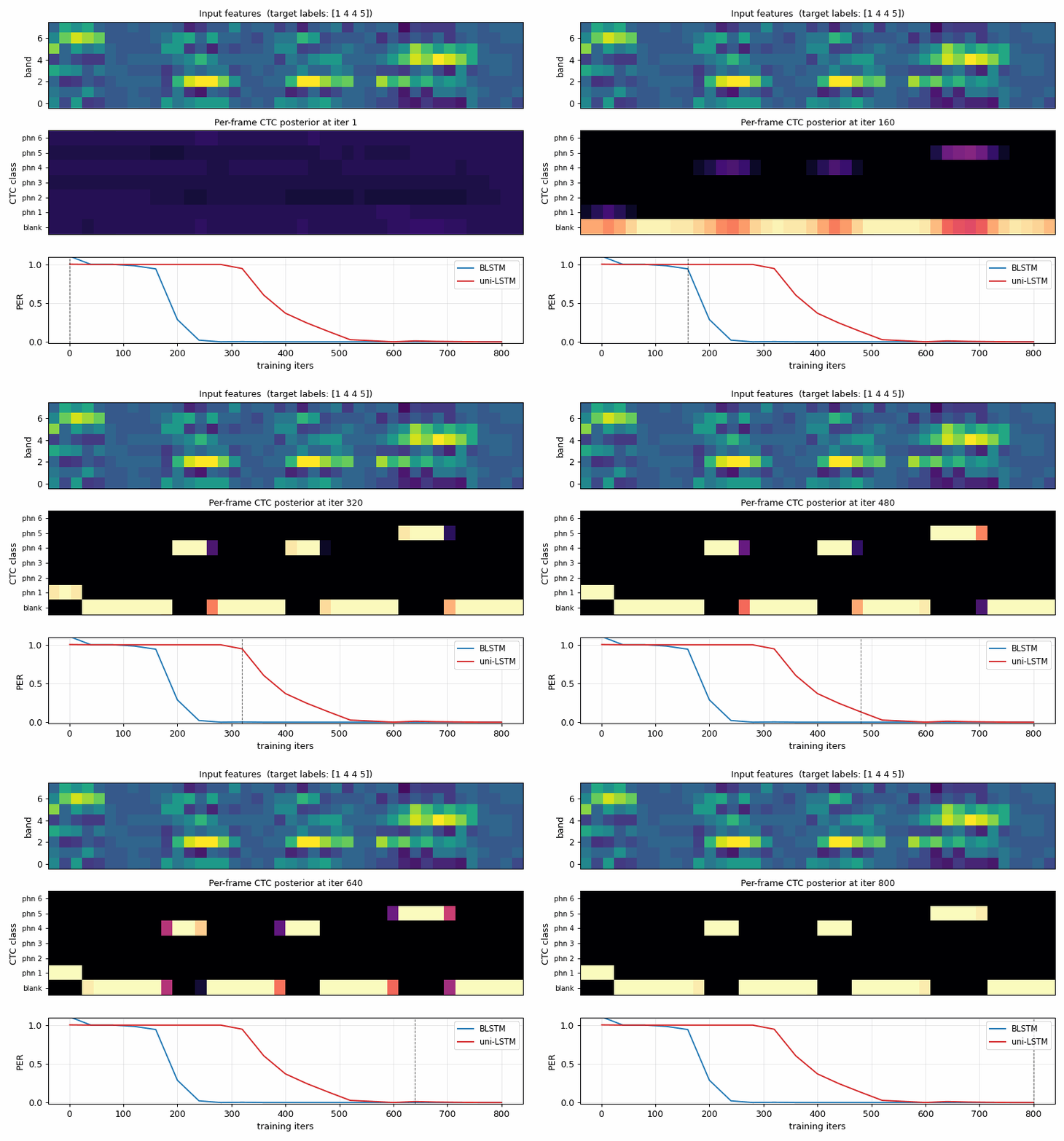
The CTC posterior of one fixed sample as the BLSTM trains.
- Top: input acoustic features (constant across frames).
- Middle: per-frame distribution over
(blank, phn 1, ..., phn K). Early in training the network spreads probability across blank + several phonemes; by ~iter 200 it has discovered sharp spike-shaped alignments where each phoneme’s late formant frames are confidently assigned to the right label and the rest is blank. This is exactly the “spike + blank” alignment Graves describes. - Bottom: held-out PER for BLSTM (blue) vs uni-LSTM (red), with a vertical line marking the current iter.
viz/training_curves.png
Three panels: CTC NLL on a log axis (BLSTM drops ~10x faster), PER on the held-out batch (BLSTM crosses 0 at iter 300, uni-LSTM at iter 500-700 depending on seed), and sequence-exact accuracy (1 if the greedy decode exactly matches the target label sequence).
viz/ctc_alignment.png
Top: input acoustic features for one held-out sequence.
Bottom: per-frame CTC posterior with rows [blank, phn 1, ..., phn 6].
Each phoneme realisation in the input gets a sharp probability spike on
its true label; everything else is blank. CTC + BLSTM has discovered
the alignment without seeing any frame-level supervision.
viz/corpus_signatures.png
The fixed spectral signatures the synthetic corpus draws from. Top row is the shared onset (used during the first ~45 % of each phoneme realisation), bottom row is the distinguishing payload. Phonemes that share an onset row are ambiguous at their start; this is what makes forward-only context insufficient.
viz/corpus_sample.png
Three example sequences from the corpus with phoneme boundaries (white
verticals) and labels (white digits). The shared-onset structure is
visible: the first frames of each phoneme often look similar across
phonemes that share a row in corpus_signatures.png.
viz/weight_matrices.png
Input-to-gate matrices of the trained forward LSTM (left), backward
LSTM (centre), and the linear output projection (right). Gate blocks
are labelled i, f, g, o. The forget-gate block (f) leans positive
(carry-by-default) thanks to the +1.0 bias initialisation. The
backward LSTM has visibly different gate patterns from the forward LSTM
– the two halves of the BLSTM specialise to opposite-direction
context.
Deviations from the original
- Synthetic phoneme corpus instead of TIMIT. The original 2005/2006 papers train on TIMIT (462 training speakers, 39 MFCC-style features at 10 ms per frame, 61 phonemes folded to 39). Per SPEC issue #1, v1 stubs use pure-numpy synthetic data so the laptop install footprint is empty. The corpus here captures the structural property the algorithm exploits (short, locally distinct units in unsegmented sequences) rather than reproducing the absolute TIMIT phoneme error rate. The exact TIMIT number (~24 % PER for BLSTM with CTC) is not reproduced here; that’s a v1.5 follow-up once a TIMIT loader is wired in.
- Co-articulated onset structure added to make the BLSTM-vs-uni-LSTM spread measurable. With phonemes whose onsets are uniquely identifiable, both architectures solve the corpus quickly. The shared-onset clusters force a phoneme’s identity to be ambiguous in the first ~45 % of its frames; only the last frames distinguish, so forward-only recurrence is at a disadvantage at exactly the time it matters.
- Forget-gate LSTM (Gers/Schmidhuber/Cummins 2000), not the
original 1997 LSTM cell. Same deviation as the rest of this catalog’s
LSTM stubs (e.g.
adding-problem,temporal-order-3bit). The forget-gate bias is initialised to+1.0so the cell is “remember by default” early in training. - Greedy CTC decoder instead of beam search. The 2006 paper uses prefix-search beam decoding for the headline TIMIT number; on the synthetic corpus greedy decoding already gets 0.000 PER, so beam search is unnecessary.
- No language model rescoring. The 2006 paper has a section on combining CTC posteriors with an n-gram language model over phonemes; for v1 we report raw CTC decode quality only.
- Hidden = 24 per direction, vs. ~100 LSTM units per direction in the paper. Smaller capacity is sufficient for a 6-class corpus and keeps the per-seed wallclock under 80 s.
- No mini-batched CTC. CTC is computed sample-by-sample inside each batch; only the LSTM matmuls are batched. A fully-batched CTC pass would be faster but the inner CTC loop is already vectorised across the expanded label-sequence axis so the per-batch wallclock cost is low.
Open questions / next experiments
- TIMIT reproduction (v1.5). Wire up a TIMIT loader (the original 39-MFCC features at 10 ms / frame) and check whether this same numpy BLSTM hits the paper’s ~24 % PER. The synthetic corpus here shows the qualitative claim; the absolute number against a framewise-classification or HMM-DNN baseline goes to v1.5.
- Beam-search CTC decode. On the harder TIMIT case, prefix-search beam decode usually saves a few percent PER over greedy. Worth measuring on this corpus once the corpus is hard enough that greedy PER > 0.
- Larger phoneme alphabets / longer sequences. K = 6 is small. Scaling to K = 24 with more co-articulation clusters would make the problem closer to TIMIT in structure and might widen the BLSTM / uni-LSTM gap (or close it, if more context lets the uni-LSTM disambiguate).
- 2D / deep BLSTM. The 2007 / 2009 follow-ups stack BLSTM layers
and add hierarchical / 2D variants for handwriting recognition (see
iam-handwriting). The same numpy substrate could host a 2-layer BLSTM; whether stacking helps on this synthetic corpus is testable. - CTC-blank rate as a diagnostic. A trained CTC model emits blank for ~80-95 % of frames; the spike rate is a clean signal of how “decisive” the model is. Plot the blank-frame rate alongside PER over training as a v2 instrumentation hook.
- ByteDMD instrumentation (v2). The full forward + backward +
CTC pass is amenable to ByteDMD: every read/write is in numpy. The
dominant data-movement cost is the per-time matmul against
Wx, Wh, Wy; the CTC log-space accumulation is a second tier. v2 would measure those movement costs and try to find a CTC variant with a better commute-to-compute ratio.