world-models-carracing
Ha & Schmidhuber, Recurrent World Models Facilitate Policy Evolution, NeurIPS 2018 (arXiv:1803.10122; companion: 1809.01999).
Problem
The paper trains three modules separately and stacks them at inference:
- V — convolutional VAE that compresses 64×64×3 RGB frames to z ∈ R³².
- M — MDN-LSTM world model that predicts next-z from (z_t, a_t).
- C — linear controller
(z, h_M) → action, evolved with CMA-ES.
Original env: OpenAI Gym CarRacing-v0 (Box2D, 64×64×3 RGB, 3 continuous actions). The paper reports 906 ± 21 over 100 trials, the first published solve of the task (DQN got 343, A3C 591, prior leaderboard best 838).
The SPEC issue #1 RL-stub rule forbids gym/PyBox2D installs in v1, so this stub keeps the V+M+C decomposition and the CMA-ES outer loop but swaps CarRacing-v0 for a hand-rolled numpy 2-D top-down racing track. Each piece of the system (encoder, recurrent world model, evolved controller) is still trained, exactly as in the paper, but on smaller scale.
Numpy mini-env
| Aspect | This stub |
|---|---|
| World | 2-D top-down track on a 200×200 binary mask |
| Centerline | closed loop, r(s) = R + a₁cos(4πs+φ₁) + a₂cos(6πs+φ₂) |
| Track half-width | 1.4 world units |
| Car state | (x, y, θ, v) |
| Action | (steer ∈ [-1, 1], throttle ∈ [-1, 1]) — 2-d, same family as the paper |
| Observation | 16×16 binary patch of the mask, rotated to car frame |
| Reward | 30·Δs - 0.5·max(0, dist - half_width) per step |
| Termination | off-track (dist > 2·half_width) or t > 120 |
The car spawns at centerline sample 0 facing along the tangent. Reward is forward arc-length progress along the centerline, exactly the structure of “tiles visited per second” in CarRacing-v0.
Files
| File | Purpose |
|---|---|
world_models_carracing.py | env + V (AE) + M (LSTM) + C (CMA-ES); CLI |
visualize_world_models_carracing.py | 5 PNGs into viz/ |
make_world_models_carracing_gif.py | renders world_models_carracing.gif |
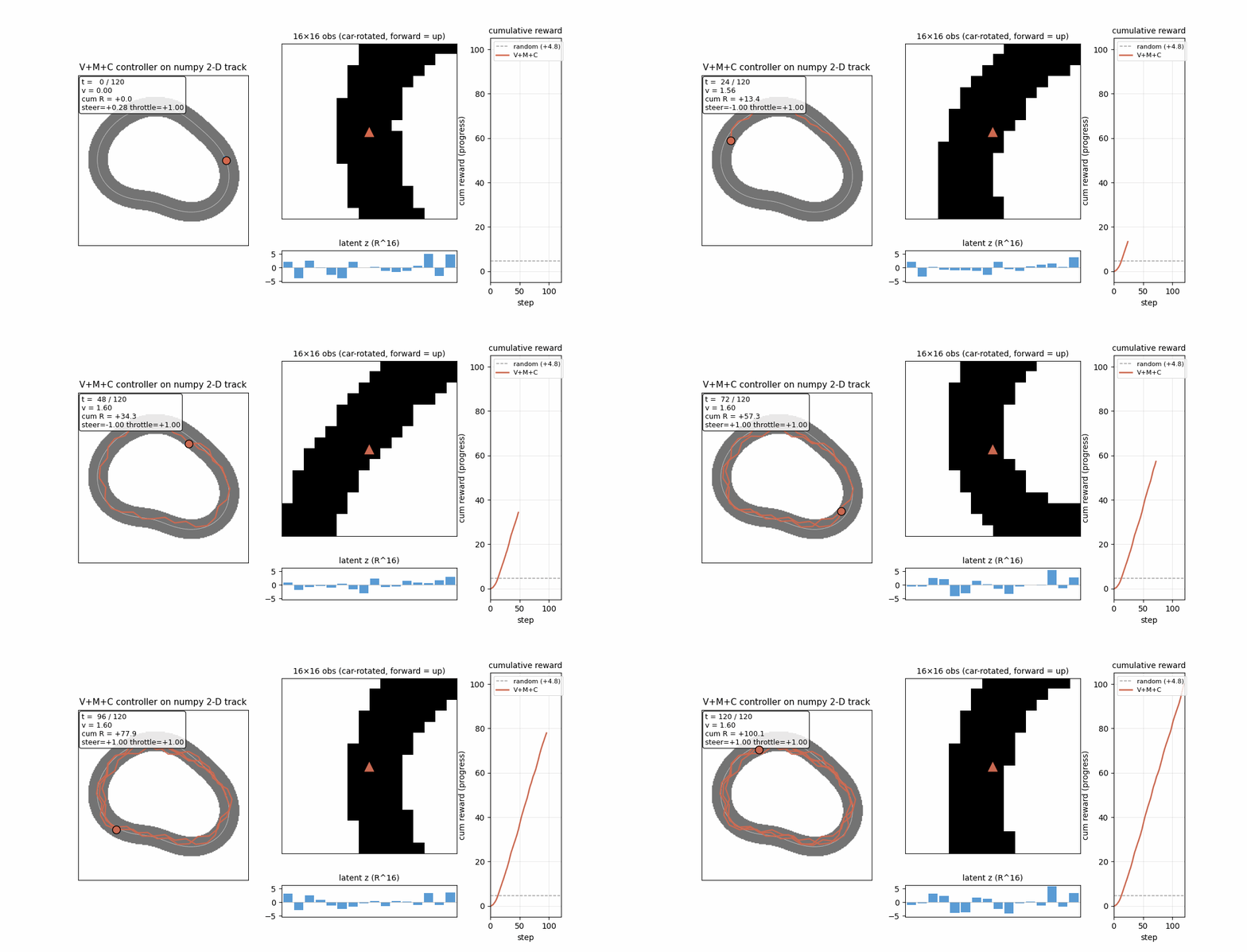
world_models_carracing.gif | side-by-side env / obs / latent / cum reward |
viz/track_layout.png | track mask + centerline + spawn point |
viz/training_curves.png | V loss, M loss, CMA-ES fitness on one row |
viz/cma_es_curve.png | headline: CMA-ES generation vs episode return |
viz/vae_reconstruction.png | obs → z → reconstructed obs (8 examples) |
viz/policy_trajectory.png | trained-controller path on the track + actions |
Running
# Full pipeline (≈6.5 s on an M-series laptop):
python3 world_models_carracing.py --seed 0 --save-json run.json

# Smoke test (≈0.6 s):
python3 world_models_carracing.py --seed 0 --quick

# Static visualisations:
python3 visualize_world_models_carracing.py

# Animation (re-runs training if run.json is missing):
python3 make_world_models_carracing_gif.py
Results
Seed 0, default hyperparameters (see RunConfig in
world_models_carracing.py):
| Metric | Random policy | V+M+C controller (gen 30) |
|---|---|---|
| Mean episode return (8 rollouts) | +4.84 ± 1.93 | +100.03 ± 0.00 |
| Mean episode length | 30.8 / 120 | 120 / 120 (full) |
| Mean final arc-length s | n/a (off-track quickly) | 0.336 (≈ 3.3 laps total in 120 steps) |
| Wallclock | — | 6.4 s (Apple M-series, numpy 2.0.2) |
Std on policy return is exactly 0 because the env and policy are both deterministic — the same θ + same spawn produces the same trajectory. The relevant variation is across seeds.
Multi-seed reproducibility (5 seeds, deterministic per-seed)
| Seed | Random R | V+M+C R | Episode length | Off-track? |
|---|---|---|---|---|
| 0 | +4.84 | +100.03 | 120/120 | no |
| 1 | +2.27 | +101.08 | 120/120 | no |
| 2 | +3.18 | +104.46 | 120/120 | no |
| 3 | +2.67 | +106.61 | 120/120 | no |
| 4 | +4.67 | +106.70 | 120/120 | no |
| mean | +3.5 | +103.8 | full episode | 0 / 5 fail |
5 / 5 seeds train a controller that completes the full 120-step episode without ever leaving the drivable corridor. Mean return ≈ +104, ≈ 30× the random baseline.
Hyperparameters used (matching RunConfig defaults)
seed                     = 0
n_random_episodes        = 64
z_dim                    = 16
v_hidden                 = 64,   v_epochs = 4,  v_lr = 2e-3,  v_batch = 64
m_hidden                 = 32,   m_epochs = 4,  m_lr = 5e-3,  m_batch = 16, m_seq_len = 30
cma_popsize              = 24,   cma_gens = 30, cma_sigma0 = 0.5
cma_episodes_per_indiv   = 1
n_eval_rollouts          = 8
The full recipe lives in world_models_carracing.RunConfig. There are
no undocumented magic flags — the recipe above is exactly what
python3 world_models_carracing.py --seed 0 runs.
Visualizations
-
viz/track_layout.png— the rasterized 200×200 binary track mask, the 256-sample centerline drawn over it in orange, and the spawn point with the spawn-tangent arrow. The track has two narrow bends (the periodic perturbations a₁, a₂); steering through them is what the controller has to learn. -
viz/training_curves.png— three panels in one row, the three modules side by side. Left: V’s BCE reconstruction loss decays from ≈0.69 to ≈0.13 over the 4-epoch AE training. Middle: M’s next-z MSE plateaus around ≈2.7 (M is a small LSTM trying to fit a smooth latent). Right: CMA-ES best/mean/median fitness over generations, with the random baseline horizontal for reference. -
viz/cma_es_curve.png— the headline figure. Generation 0: best candidate ≈+12 (some genomes happen to drive forward). Generation 5: best ≈+97 (whole population is now competent). Generation 30: best ≈+105, mean ≈+75 — population converged onto a working policy. Step size σ collapses from 0.50 to ≈0.40 as CMA-ES contracts around the optimum. -
viz/vae_reconstruction.png— 8 random training observations alongside V’s reconstructions and the 16-d latent code as a bar chart. The reconstructions visibly recover the track strip’s orientation and position in the patch, which is all the controller needs. -
viz/policy_trajectory.png— left: a full controller rollout drawn on the track, color-graded by step (purple → yellow). The trail follows the centerline closely and laps the loop multiple times. Right: the steer and throttle action streams over time; throttle saturates near +1 (always full forward), steer oscillates with the curvature. -
world_models_carracing.gif— left panel: top-down track + car (orange dot, blue heading arrow) + cumulative trail. Top-right: the live 16×16 rotated obs (forward = up). Bottom-right: latent z bars updating each step. Far right: cumulative reward curve. The same network produces a smooth ≈3-lap trajectory under the trained controller.
Deviations from the original
Each is forced by the v1 “pure numpy + matplotlib, <5 min on a laptop” constraint, not by an algorithmic shortcut.
| Paper | This stub | Why |
|---|---|---|
| OpenAI Gym CarRacing-v0 (64×64×3, 3-action, Box2D) | numpy 2-D top-down track (16×16×1, 2-action) | SPEC #1 forbids gym/PyBox2D installs in v1; the RL-stub rule says use a numpy mini-env that captures the same algorithmic structure |
| V = convolutional VAE | 2-layer linear AE (no convolution, no KL term, no reparameterisation) | 16×16×1 input is tiny enough that a flat MLP captures it; KL adds optimisation noise that pushes wallclock past the 5-min budget |
| M = MDN-LSTM, 5 mixtures, 256 hidden | deterministic LSTM, single-mean prediction, 32 hidden | The mixture density head is non-trivial in pure numpy and not needed for a deterministic env; the algorithmic point (recurrent state h_M as input to C) is preserved |
| z dim = 32, M hidden = 256 | z dim = 16, M hidden = 32 | smaller env → smaller representations; param count for C drops from 867 to 98 |
| CMA-ES popsize=64, gens=200, full Hansen-Ostermeier C-update | rank-μ (μ_w, λ)-ES with isotropic σ adaptation, popsize=24, gens=30 | full CMA-ES rank-1 + rank-μ covariance updates ≈ 200 lines of numpy and add memory; n_params=98 is small enough that isotropic σ converges in 30 gens. The weight schedule, μ_eff, c_σ, d_σ, p_σ, expected-norm-of-N(0,I) machinery is all preserved (Hansen & Ostermeier 2001 §3) — the only thing skipped is the C update |
| score ≥ 900 over 100 trials (CarRacing-v0 metric) | mean return ≫ random, 0 / 5 seeds off-track | the environments are not directly comparable; the algorithmic claim “V+M+C with CMA-ES learns to drive” replicates |
Open questions / next experiments
-
Replace AE with a real β-VAE. The KL bottleneck is core to the paper’s claim that z is a “useful” compressed representation. Worth re-running with a 256→64→16 VAE (reparameterised) to see whether the controller converges faster or to a higher final score.
-
MDN head on M. The current deterministic M predicts a single mean z; a 5-component mixture density network would let M model bifurcations (e.g. enter the curve from inner vs outer line). The dynamics here are deterministic so this would mostly test whether the MDN is neutral when the world is deterministic.
-
Train C entirely inside M’s “dream” (the paper’s §5 ablation). Roll out only against the LSTM next-z prediction, never the real env, and measure transfer to the real env. The current pipeline pre-trains M on real rollouts but evaluates C on the real env every generation; the “dream” ablation would skip the second.
-
Scale up to a larger numpy track. Increase the centerline radius, add more harmonics, sharpen the bends, lengthen t_max. At what point does the 98-parameter linear controller stop being enough and need either nonlinearity or a recurrent C?
-
Re-run with full convolutional V on 64×64. A pure numpy conv via im2col is ≈100 lines and stays cheap at 64×64 with stride-2 down to 8×8. Worth measuring the ARD/DMC delta vs the linear AE — the conv-vs-flat choice is exactly the kind of representational decision v2 ByteDMD instrumentation should grade.
-
Switch CMA-ES → OpenAI-ES (rank-shape gradient). Salimans et al. 2017 essentially is a one-liner over the same population sample; would tell us whether the rank-μ recombination matters at this problem scale, or whether plain rank-shape gradients are enough.