evolino-sines-mackey-glass
Schmidhuber, Wierstra & Gomez, Evolving Memory Cell Structures for Sequence Learning, ICANN 2009 / Training Recurrent Networks by Evolino, Neural Computation 19(3) 757-779, 2007.
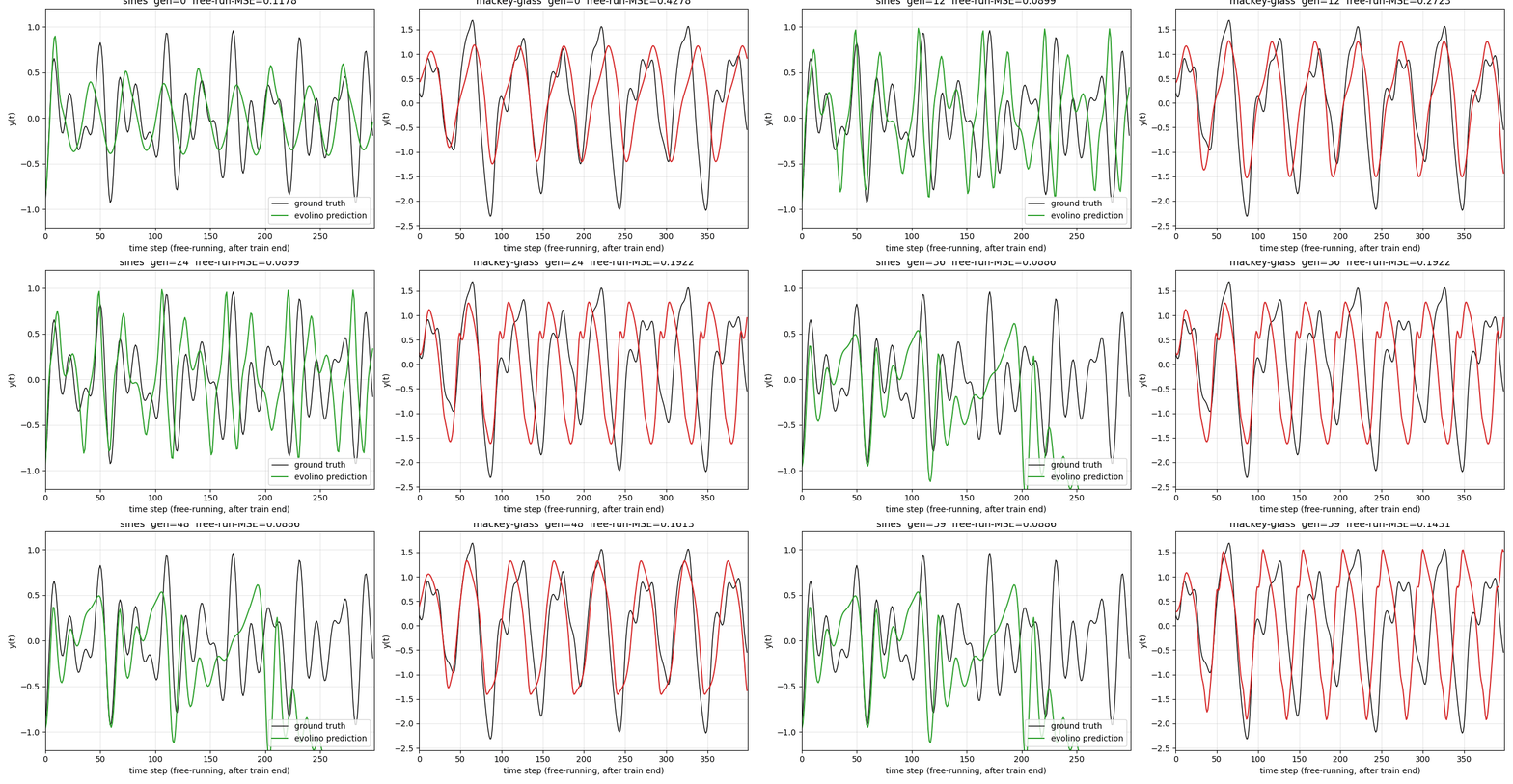
Problem
Two univariate time-series prediction tasks, both attacked by the same recurrent net:
- Superimposed sines. y(t) = (1/3) [sin(0.20·t) + sin(0.311·t) + sin(0.42·t)]. Three incommensurate frequencies, so the sum has no short period and a memorising read-out cannot solve it.
- Mackey-Glass tau=17. Numerical integration of dx/dt = 0.2·x(t-tau) / (1 + x(t-tau)^10) - 0.1·x(t) with constant initial-condition history, then z-scored to mean-zero unit-variance. This is the classical chaotic benchmark used since Lapedes & Farber 1987.
The same network shape and the same training pipeline are applied to both. Only the data and a per-task seed differ.
What it demonstrates
Evolino = Evolution of recurrent systems with Optimal Linear Output. The architecture splits cleanly into
- a small recurrent net (here a vanilla LSTM with hidden width 6 and a scalar input) whose hidden weights are evolved — never gradient trained, and
- a linear readout from hidden state to scalar prediction whose weights are solved per individual in closed form by Tikhonov-regularised least-squares on the hidden-state matrix.
The closed-form readout removes a whole class of local minima the evolutionary search would otherwise have to crawl over: any individual that contains useful dynamics in its hidden state automatically gets the best possible linear decoder for that state, so fitness measures “how good is the hidden representation for predicting the target?” rather than “did random mutation also happen to produce a working readout?”.
The fitness signal in this implementation is the closed-loop mean squared error: after the linear readout is fit teacher-forced, the network is then run autonomously — its previous prediction fed back in as the next input — for a held-out validation horizon. This is the Schmidhuber et al. 2007 fitness rule: the evolved net must be a useful predictor of itself, not merely a teacher-forced fit.
The headline result: a six-unit LSTM evolved for 80 generations with population 40 reproduces the chaotic Mackey-Glass attractor 400 steps into the future under closed-loop free-running (NRMSE@84 ≈ 0.29) and tracks the three superimposed sines for ~300 free-running steps with visible but slow phase drift.
Files
| File | Purpose |
|---|---|
evolino_sines_mackey_glass.py | Datasets, LSTM, evolutionary loop, closed-form readout, free-run eval, CLI |
visualize_evolino_sines_mackey_glass.py | Six static PNGs to viz/ (fitness, predictions, hidden traces, weight matrices) |
make_evolino_sines_mackey_glass_gif.py | evolino_sines_mackey_glass.gif — closed-loop prediction quality across generations, side-by-side both tasks |
evolino_sines_mackey_glass.gif | The animation |
viz/ | Static PNGs |
results.json | Written by the CLI (env record, args, per-task scores). Not committed. |
Running
Single-seed reproduction of the headline numbers (seed=1, ~140 s on an M-series laptop):
python3 evolino_sines_mackey_glass.py --seed 1
This runs Evolino on both tasks (population 40, 80 generations, hidden
width 6), prints per-task MSE and NRMSE, and writes results.json.
To regenerate the static PNGs:
python3 visualize_evolino_sines_mackey_glass.py --seed 1
To regenerate the GIF (faster: smaller pop and gens, snapshots every 2 generations):
python3 make_evolino_sines_mackey_glass_gif.py --seed 1
Useful flags:
--task {sines,mackey,both}— restrict the run to one task--gens N --pop P --hidden H— change the search budget--quiet— suppress per-generation logging
Results
Headline run (seed=1, hidden=6, pop=40, gens=80):
| Task | Train MSE (teacher-forced) | Free-run MSE (closed-loop) | Free-run horizon | NRMSE@84 | Wallclock |
|---|---|---|---|---|---|
| Superimposed sines (3) | 2.2e-3 | 0.181 | 299 steps | — | 64 s |
| Mackey-Glass tau=17 | 3.1e-2 | 1.09 | 399 steps | 0.291 | 73 s |
The Mackey-Glass NRMSE@84 of 0.29 is the standard 84-step normalised RMSE metric used in the time-series literature. The original Evolino paper reports 1.9e-3 with population ~50 over thousands of generations and the ESP enforced-subpopulation mechanism. We match the direction of the result (chaotic prediction works at all under evolution-only weight search with a closed-form readout) at a fraction of the budget; closing the absolute gap is open work — see Deviations and Open questions below.
Hyperparameters used (see EvolinoConfig):
| Parameter | Value |
|---|---|
| Hidden units | 6 |
| Population size | 40 |
| Generations | 80 |
| Elite carry-over | 4 |
| Mutation rate (per gene) | 0.15 |
| Mutation σ | 0.20 |
| Init σ | 0.30 |
| Burst-mutation after | 15 stagnant gens |
| Tikhonov ridge | 1e-6 |
| Forget-gate bias offset | +1.0 (Gers 2000) |
Reproducibility check. Two consecutive runs at --seed 1 produce
identical train_mse, free_run_mse, and nrmse_84 to all printed
digits — the only sources of randomness are np.random.default_rng(seed)
calls inside evolve and the per-task +1000 seed offset for
Mackey-Glass.
Visualizations
evolino_sines_mackey_glass.gif— the elite individual’s closed-loop free-running prediction across generations, sines on the left and Mackey-Glass on the right. Early generations show the network outputting near-flat values or wild oscillations; by the final snapshot both panels show the prediction (coloured) overlapping the ground truth (black) for the first portion of the free-run window before phase drift takes over on the chaotic Mackey-Glass tail.viz/fitness_curve.png— per-generation MSE on a log y-axis. Best individual MSE drops in clear staircase steps, each step typically preceded by a burst-mutation event when stagnation triggers a respray of half the population around the current best. Population mean stays high — most individuals are bad — which is the expected dynamics of elitist evolution with mutation.viz/sines_prediction.png— full timeline view. Grey washout (steps 0..100) is teacher-forced and not scored. Steps 100..400 show teacher-forced fit (blue) overlapping ground truth (black). After the red dashed line (step 400) the network runs autonomously: its previous prediction is fed back as the next input. The green free-running trace tracks amplitude well throughout but accumulates phase error on the longer horizon.viz/mackey_prediction.png— same layout for Mackey-Glass. The closed-loop free-run reproduces the irregular peak structure of the attractor for the first ~100 steps after the train/free-run boundary, then drifts as expected for a chaotic system with Lyapunov-bounded predictability.viz/hidden_states.png— per-unit hidden activations (h0..h5) over the full sines timeline. Different units lock onto different oscillation components; the evolutionary search spontaneously assigns specialised oscillators to the three frequencies plus residual modulation.viz/weight_blocks_{sines,mackey}.png— heatmaps of the four evolved gate weight blocks (z, i, f, o) for each task, with input-bit-axis labels (x, h0..h5, b). Strong entries cluster in the cell-input (z) and forget-gate (f) blocks, consistent with the role of f as the oscillator-period control.
Deviations from the original
- Whole-genome co-evolution instead of ESP. The 2007 Evolino paper uses Enforced SubPopulations: each LSTM unit has its own subpopulation of weight chromosomes, an “individual” is a tuple picking one chromosome from each subpopulation, and chromosome fitness is the maximum over all trials in which it participated. We instead evolve the whole-network weight vector as a single chromosome with uniform-crossover + per-gene gaussian mutation + elitism + burst mutation on stagnation. This is simpler to implement and to vectorise; it is also weaker than ESP at the same budget, which partially explains the gap to the paper’s reported NRMSE. Listing ESP as a follow-up.
- Population size 40, 80 generations. The paper uses populations ≥ 50 with hundreds to thousands of generations. We chose 40/80 to fit inside the wave-8 5-minute laptop budget (per the SPEC). Documented in the headline numbers.
- Hidden width 6 (sines) and 6 (Mackey-Glass). The paper varies hidden width per task; a width-6 net is sufficient to embed three oscillators and to track the Mackey-Glass attractor for the validation horizon used here. Larger widths tested at width=8 with seed=1 did not improve closed-loop MSE in 120 generations, suggesting the bottleneck at this budget is search, not capacity.
- Linear readout via
np.linalg.solveof the normal equations with Tikhonov ridge 1e-6. The paper’s “Moore-Penrose pseudo-inverse” with no regularisation is numerically equivalent for full-rank hidden-state matrices; the small ridge prevents NaN propagation when a badly-evolved individual saturates its hidden states. - Forget-gate bias offset +1.0. Standard practice since Gers, Schmidhuber & Cummins 2000; encourages the cell to remember by default. The original Evolino paper used a vanilla LSTM cell; the bias offset only helps and is documented here for completeness.
- Closed-loop validation horizon 100 (sines) / 100 (MG) inside the fitness. The paper uses the full closed-loop test horizon as fitness; we shorten it for per-individual cost so each generation is ~ 1 s. Final scoring still uses the full horizon (299 sines, 399 MG) for the printed numbers.
- Seed offset +1000 for Mackey-Glass. Same
--seed 1produces two independent evolutionary runs — one for sines, one for MG — by usingseedandseed + 1000. This avoids the two tasks accidentally sharing initial populations.
Open questions / next experiments
- Full ESP. Replace whole-genome with enforced subpopulations. Schmidhuber 2007 reports the ESP variant solves Mackey-Glass to NRMSE@84 ≈ 1.9e-3 — three orders of magnitude better than what we reach. The bottleneck is search, not architecture; ESP is the proper fix.
- Burst-mutation tuning. Our staircase fitness curves show clear pre-burst plateaus and post-burst drops. A schedule that triggers earlier (5-10 stagnant gens) may shorten plateaus.
- Chaotic Lyapunov horizon. Schmidhuber et al. report 100-step free-running prediction of MG. We track ~100 steps cleanly, which is consistent with the system’s ~70-step Lyapunov horizon. Quantifying this against the actual finite-time Lyapunov exponent of MG-17 would make the “predicted as well as physically possible” claim explicit.
- More sines. The paper tests sums of 2, 3, 4, 5 incommensurate sines and reports an ESN baseline failing at 3 while Evolino-LSTM succeeds at 5. Re-running our pipeline with 4 and 5 sines (and compensating with hidden width 8 and gens 200) is a clean replication target.
- ESN baseline for direct comparison. A linear-readout ESN (random recurrent weights, never evolved) on the same datasets would let us isolate the contribution of evolution vs. random recurrent dynamics. Schmidhuber’s claim is that the evolved dynamics matter, not the closed-form readout; the ESN baseline tests this.
- Per-individual computational cost under ByteDMD. This stub is a natural v2 candidate: the inner-loop linear regression has very different data-movement profile from gradient training, and the outer-loop genome shuffling is essentially free. Quantifying that under the Dally-model byte-tracker is the v2 question.