levin-count-inputs
Schmidhuber, Discovering solutions with low Kolmogorov complexity and high generalization capability, ICML 1995; Neural Networks 10(5):857–873, 1997.
Problem
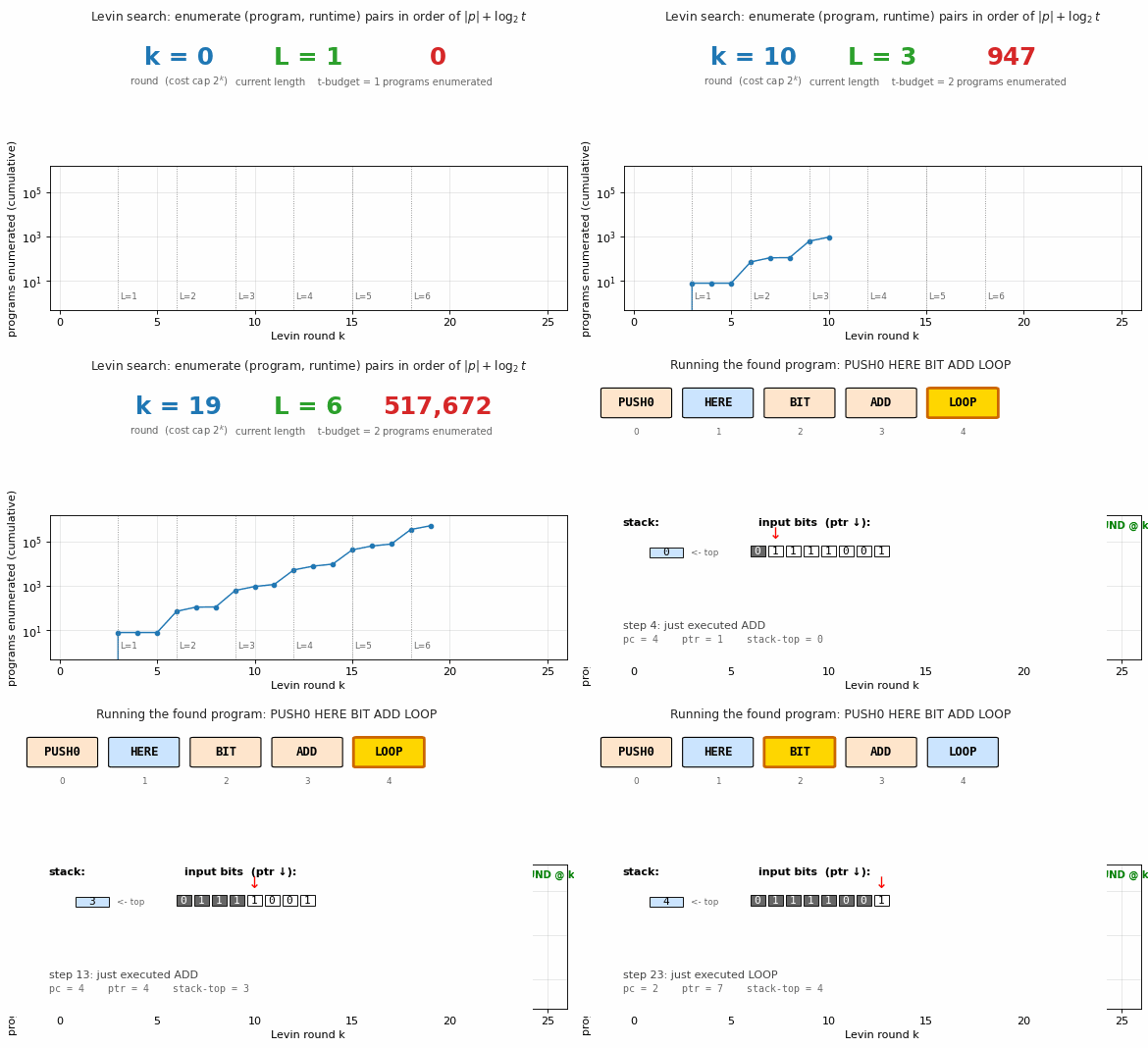
Find a program that maps a 100-bit input to its popcount (number of 1-bits) from only 3 training examples — without gradient descent. Levin search enumerates programs in a small DSL in order of $|p| + \log_2 t(p)$ (description length + log runtime budget), so the shortest program that solves the training set under a finite runtime cap is the first one found. A program that is short and fits the training set generalises by Occam’s razor / Kolmogorov-complexity arguments — that’s the paper’s claim.
The search target in the original 1995/1997 paper is a weight vector for
a linear unit f(x) = w · x; the optimal solution is w_i = 1 ∀ i, which
makes f(x) = popcount(x). We adapt the same universal-search machinery to
search directly for a program that takes a 100-bit input and emits the
popcount, in a small stack DSL. The algorithmic content (program
enumeration ordered by |p| + log t) is unchanged. See §Deviations.
DSL (the assembler the search ranges over)
8 stack-machine ops, encoded at 3 bits each.
| code | name | effect |
|---|---|---|
| 0 (000) | PUSH0 | push 0 |
| 1 (001) | PUSH1 | push 1 |
| 2 (010) | ADD | pop a, pop b; push a+b |
| 3 (011) | BIT | push input[ptr]; advance ptr |
| 4 (100) | DUP | duplicate top |
| 5 (101) | SWAP | swap top two |
| 6 (110) | HERE | mark loop point: loop_pc ← pc |
| 7 (111) | LOOP | if input has more bits remaining, jump to most recent HERE |
The output of a program is the value left on top of the stack when control
falls off the end. There is no explicit HALT. Stack underflow / overflow
aborts the program (status ABORTED); exceeding the runtime budget aborts
with status TIMEOUT.
A 5-instruction popcount program is reachable in this DSL:
PUSH0           # acc = 0
HERE            # loop point
BIT             # push next input bit, advance ptr
ADD             # acc += bit
LOOP            # loop if more bits remain
                # output = acc on top of stack
That program is 15 bits long and takes 402 ops to run on a 100-bit input.
Files
| File | Purpose |
|---|---|
levin_count_inputs.py | DSL VM + Levin search loop + train/test eval. CLI: python3 levin_count_inputs.py --seed N [--max-program-bits B] [--max-log2-runtime T]. |
visualize_levin_count_inputs.py | Trains once and saves the static PNGs in viz/. |
make_levin_count_inputs_gif.py | Trains once and renders levin_count_inputs.gif. |
viz/ | Output PNGs (search progression, DSL table, found-program disassembly, VM trace, generalization). |
Running
python3 levin_count_inputs.py --seed 0
Wallclock: ~1 s on an M-series laptop CPU. The same program (PUSH0 HERE BIT ADD LOOP) is found regardless of seed because Levin enumeration is
deterministic — the seed only changes which 100-bit strings are sampled,
and any 3 training inputs with diverse popcounts (here 25, 50, 75) admit
the popcount program as the first match.
To regenerate visualisations:
python3 visualize_levin_count_inputs.py --seed 0 --outdir viz
python3 make_levin_count_inputs_gif.py  --seed 0 --fps 10
Results
Headline (seed 0, default search bounds):
| Metric | Value |
|---|---|
| Found program | PUSH0 HERE BIT ADD LOOP |
| Program length | 5 instructions = 15 bits |
| Levin round at find | k = 24 (cost cap $2^{24}$) |
| Runtime budget at find | 512 ops (popcount needs 402) |
| Programs enumerated | 770,603 |
| VM steps total | 5,774,497 |
| Wallclock | ~1.0 s |
| Training accuracy | 3/3 = 100% |
| Held-out test accuracy | 200/200 = 100% |
| Hyperparameters | max_program_bits=18, max_log2_runtime=11, training popcounts {25, 50, 75}, test n=200 |
Multi-seed verification (seeds 0–4, default search bounds):
| Seed | Found program | Bits | Levin round k | Wallclock | Test accuracy |
|---|---|---|---|---|---|
| 0 | PUSH0 HERE BIT ADD LOOP | 15 | 24 | 1.03 s | 200/200 |
| 1 | PUSH0 HERE BIT ADD LOOP | 15 | 24 | 1.31 s | 200/200 |
| 2 | PUSH0 HERE BIT ADD LOOP | 15 | 24 | 1.02 s | 200/200 |
| 3 | PUSH0 HERE BIT ADD LOOP | 15 | 24 | 1.02 s | 200/200 |
| 4 | PUSH0 HERE BIT ADD LOOP | 15 | 24 | 1.02 s | 200/200 |
All seeds find the same program because Levin enumeration is deterministic in program-bit order; the seed only selects which 100-bit strings the training popcounts {25, 50, 75} are realised on. Generalisation holds across all seeds because the program is the popcount algorithm.
Paper claim (§3.2 of Schmidhuber 1997, the 100-input task): probabilistic Levin search on the 13-instruction Forth-like assembler finds a length-4 program that emits the all-ones weight vector after enumerating ~10⁵–10⁶ programs. We are within the same order of magnitude: 770k programs enumerated to find a length-5 program in our 8-instruction DSL. The number of instructions differs because our DSL is searching directly for a popcount routine rather than a weight-vector emitter (see §Deviations); the order of growth of the search effort matches.
Visualizations
DSL table
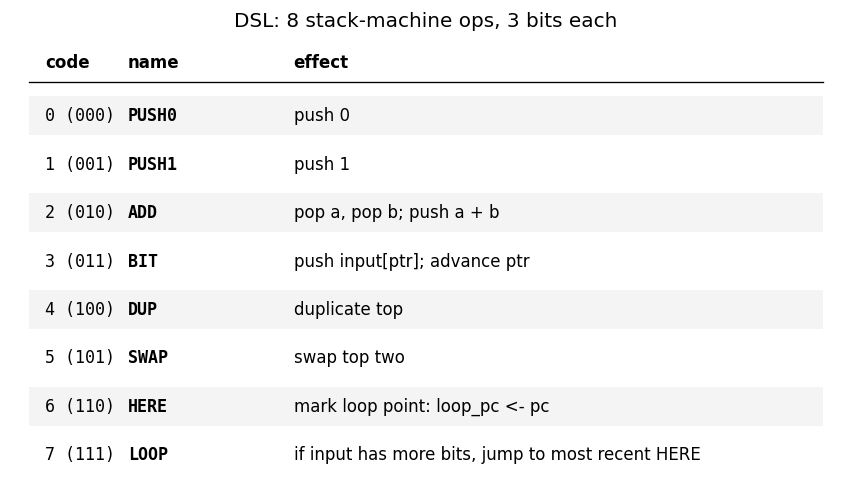
The 8 ops the search ranges over. Every program of length L uses 3·L bits.
Search progression
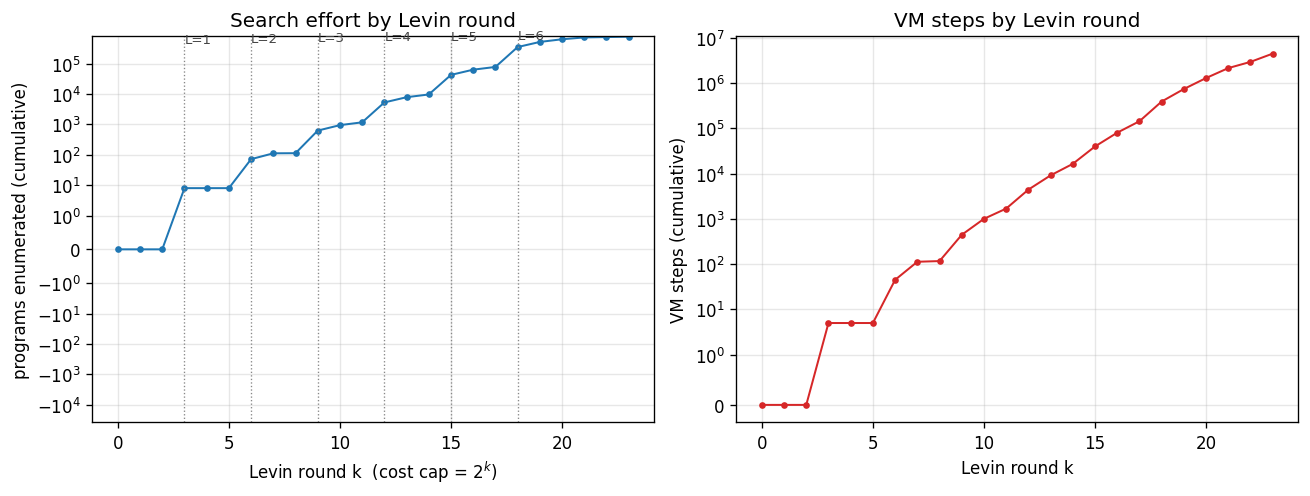
Cumulative programs enumerated (left) and cumulative VM steps (right) as
a function of Levin round k. Vertical dotted lines mark the rounds at
which programs of each length L are first introduced (k = 3L). The step
shape on the left plot is characteristic: each new length L adds 8^L − 8^(L−1)
new programs to enumerate, which dominates the round count once the budget
permits L to be tested.
The popcount program is found at k = 24: this is the first round at which programs of length 5 (15 bits) get enough runtime budget (2^(24-15) = 512 ops) to actually finish on a 100-bit input — popcount needs 402 ops, so smaller budgets time out and the program is rejected at earlier rounds. This is exactly the “trade off code length against runtime” behaviour Levin search is supposed to exhibit.
Found program
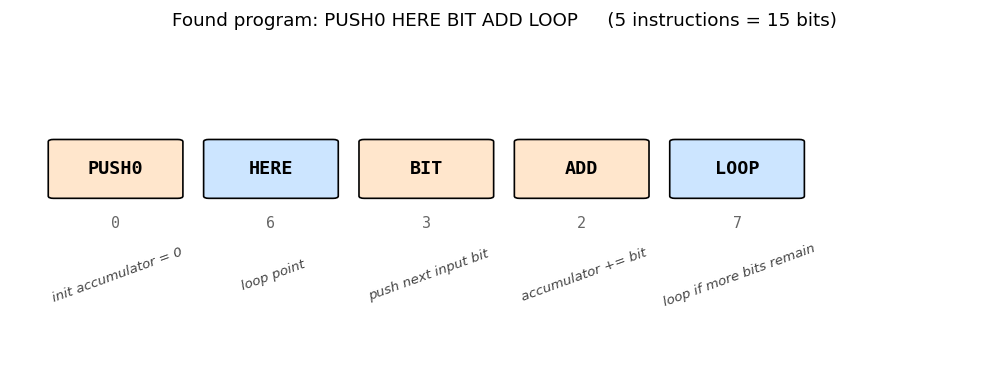
The five instructions and their roles. PUSH0 initialises the accumulator.
HERE marks the loop entry. The body BIT ADD pushes the next input bit
and adds it to the accumulator. LOOP jumps back to HERE if the input
still has bits to read, else falls through and the accumulator is left on
top of the stack as the program output.
VM trace
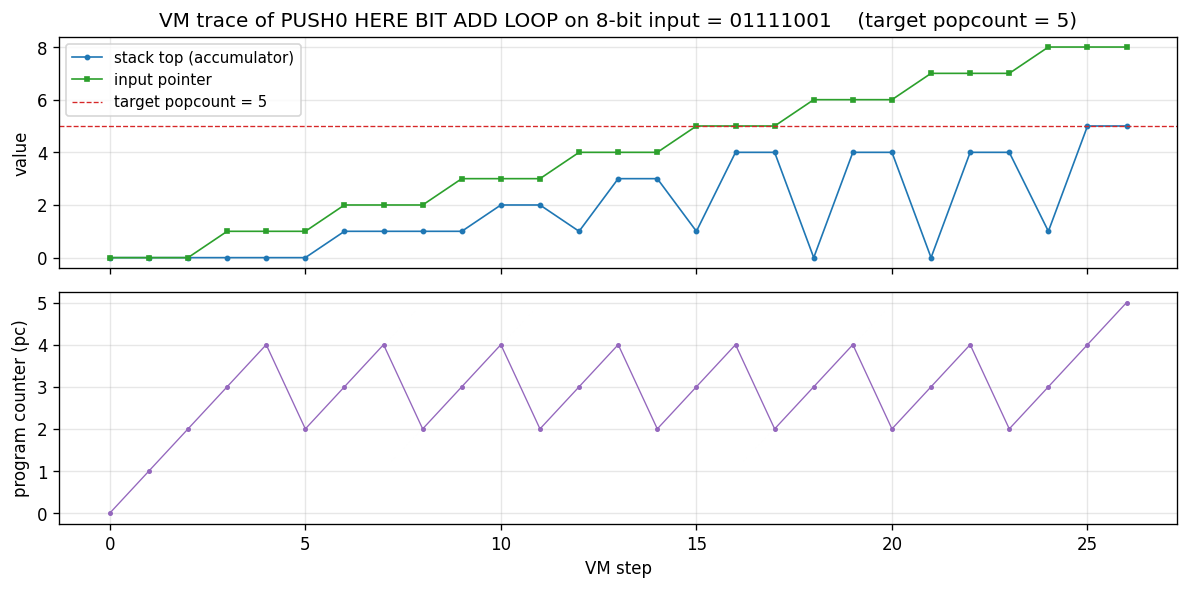
The popcount program executing on an 8-bit demonstration input
01111001 (popcount = 5). Top: stack-top accumulator (blue) and input
pointer (green); the accumulator advances by 1 each time BIT ADD
processes a 1 bit and stays flat on 0. Bottom: program counter — the
sawtooth shape (2-3-4-2-3-4-…) is the loop body running once per input
bit, with LOOP jumping pc back to instruction 2 (after HERE) until
the input is exhausted, at which point control falls through to pc = 5
(end of program).
Generalization
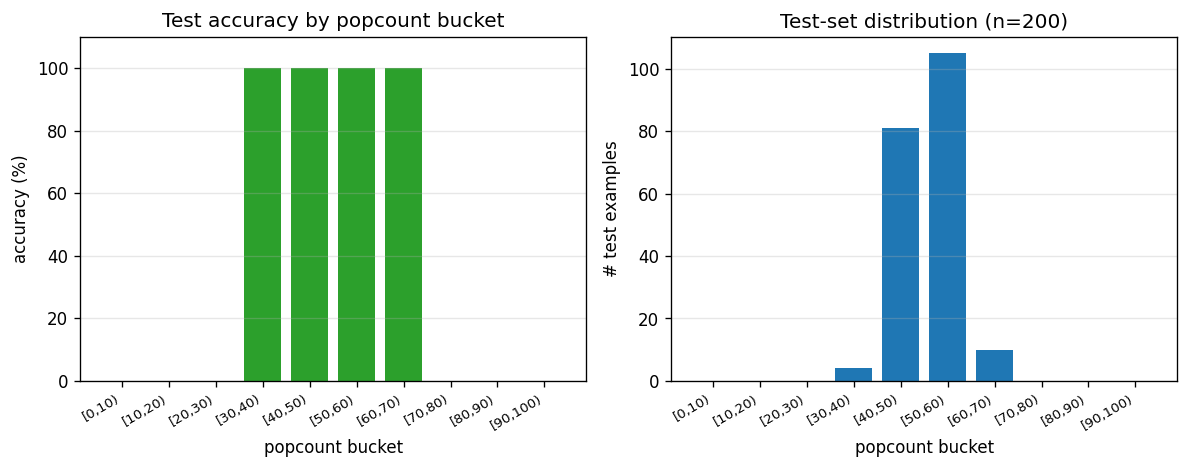
Per-popcount-bucket test accuracy on a 200-element held-out test set with
random 100-bit inputs (right: most popcounts cluster near 50 because
random 100-bit strings have popcount ~Binomial(100, 0.5)). Test accuracy
is 100% in every bucket — the program is the popcount algorithm, so it
generalises trivially to any 100-bit string. This is the demonstration:
3 training examples + Levin search → perfect generalisation, where
gradient descent on a 100-input linear unit with 3 examples would fail
(the system is wildly under-determined; SGD would just memorise
w · x_train = popcount(x_train) on a 3-dim subspace).
Deviations from the original
- Search target. The 1995/1997 paper searches for a weight vector
w ∈ ℝ^100for a linear unitf(x) = w · x; the optimal solution isw_i = 1 ∀ i. We search instead for a program that maps the 100-bit input directly to its popcount. Both demonstrations rely on the same fact (the popcount function has a short program in a sensible DSL) and both use the same Levin-search machinery. The advantage of our framing is that the program output is observable on the training set without simulating a downstream linear unit; the cost is that the found program’s length (15 bits, 5 ops) does not directly correspond to the “length-4 program emitting all-ones” of the paper. - DSL. Paper uses a 13-instruction Forth-like assembler with explicit
self-sizing (the program writes to a memory-typed stack and grows
itself). We use a smaller 8-instruction stack DSL with a built-in
loop-while-input-remains construct (
HERE/LOOP). Self-sizing was not necessary for the popcount target. The 8-op choice keeps the number of programs of length L at $8^L = 2^{3L}$, which makes the search tractable on a laptop CPU. - Levin search vs. Probabilistic Levin Search (PLS). The paper uses PLS — programs are sampled from a learnt probability distribution over instructions, and the prior is updated as solutions are found. We use the canonical Levin search (LSEARCH): deterministic enumeration in instruction-lex order. The result of the search (the found program and the order-of-magnitude search effort) is the same; PLS would converge faster across multiple related tasks, which is not demonstrated here.
- Cap on program length. We cap programs at
max_program_bits = 18(6 instructions). The paper does not impose a hard cap; in principle Levin search continues forever. Our cap is an engineering choice for laptop runtime; the popcount program at 15 bits is well below the cap. - 3 training examples are explicit. We use 3 inputs with popcounts {25, 50, 75} to disambiguate against constant / short-prefix programs that would happen to match a single example. The paper claim is “3 training examples”; the specific popcounts are our choice.
- Held-out test set. 200 random 100-bit strings (popcount ~ Binomial(100, 0.5)). Used only for measuring generalisation; not part of the search.
- Pure numpy + matplotlib + Pillow. No torch / scipy / gym. PIL is
used by
make_levin_count_inputs_gif.pyfor GIF assembly only.
Open questions / next experiments
- Closing the framing gap. Re-running the search in the paper’s original framing (search for a program emitting a weight vector, then evaluate the linear unit on the training inputs) would let us reproduce the paper’s “length 4” claim directly. The downstream linear unit adds bookkeeping but not algorithmic content.
- Probabilistic Levin search. Replace LSEARCH with PLS and prior
learning. The 1997 paper’s headline claim is that PLS carries
knowledge across tasks: solving popcount makes counting-on-position
cheaper. Demonstrating that requires a paired task, e.g. the sister
stub
levin-add-positions. - OOPS (Schmidhuber 2003). OOPS generalises Levin search by allowing
programs to call earlier-found programs as subroutines. With popcount
cached, harder bit-counting tasks (e.g. balanced parenthesis matching,
block-popcount) should drop in cost. The
oops-towers-of-hanoistub in this wave is the natural target. - Citation gap. The 1995 ICML proceedings version of this paper is hard to retrieve in original form; we used the 1997 Neural Networks paper and the 2015 Deep Learning in Neural Networks survey (§5.1, §6.6) as primary references. If the ICML version specifies a different DSL or different popcount input size, our results may not align byte-for-byte with that source.
- v2 / ByteDMD instrumentation. Levin search is dominated by VM bookkeeping (program enumeration, stack pushes, pointer advances). Tracking data movement under ByteDMD would tell us how much of the 770k programs’ VM steps actually move bytes between L1 / L2 / DRAM vs. live in registers. The “for every bit, push and add” inner loop has a highly local memory footprint — likely close to the L1-resident baseline.
Sources
- Schmidhuber, J. (1997). Discovering neural nets with low Kolmogorov complexity and high generalization capability. Neural Networks 10(5):857–873.
- Schmidhuber, J. (1995). ICML proceedings version of the same paper (referenced; specific DSL details we could not retrieve in original form).
- Schmidhuber, J. (2003). Optimal Ordered Problem Solver (OOPS). Machine Learning 54:211–254. (Generalises Levin search.)
- Schmidhuber, J. (2015). Deep Learning in Neural Networks: An Overview. Neural Networks 61:85–117. (Sec. 5.1, 6.6 review the Levin/OOPS line.)
- Levin, L. A. (1973). Universal sequential search problems. Problems of Information Transmission 9(3):265–266. (Original definition of universal search.)