noise-free-long-lag
Hochreiter & Schmidhuber, Long Short-Term Memory, Neural Computation 9(8):1735-1780 (1997), Experiment 2 (sub-variant a).
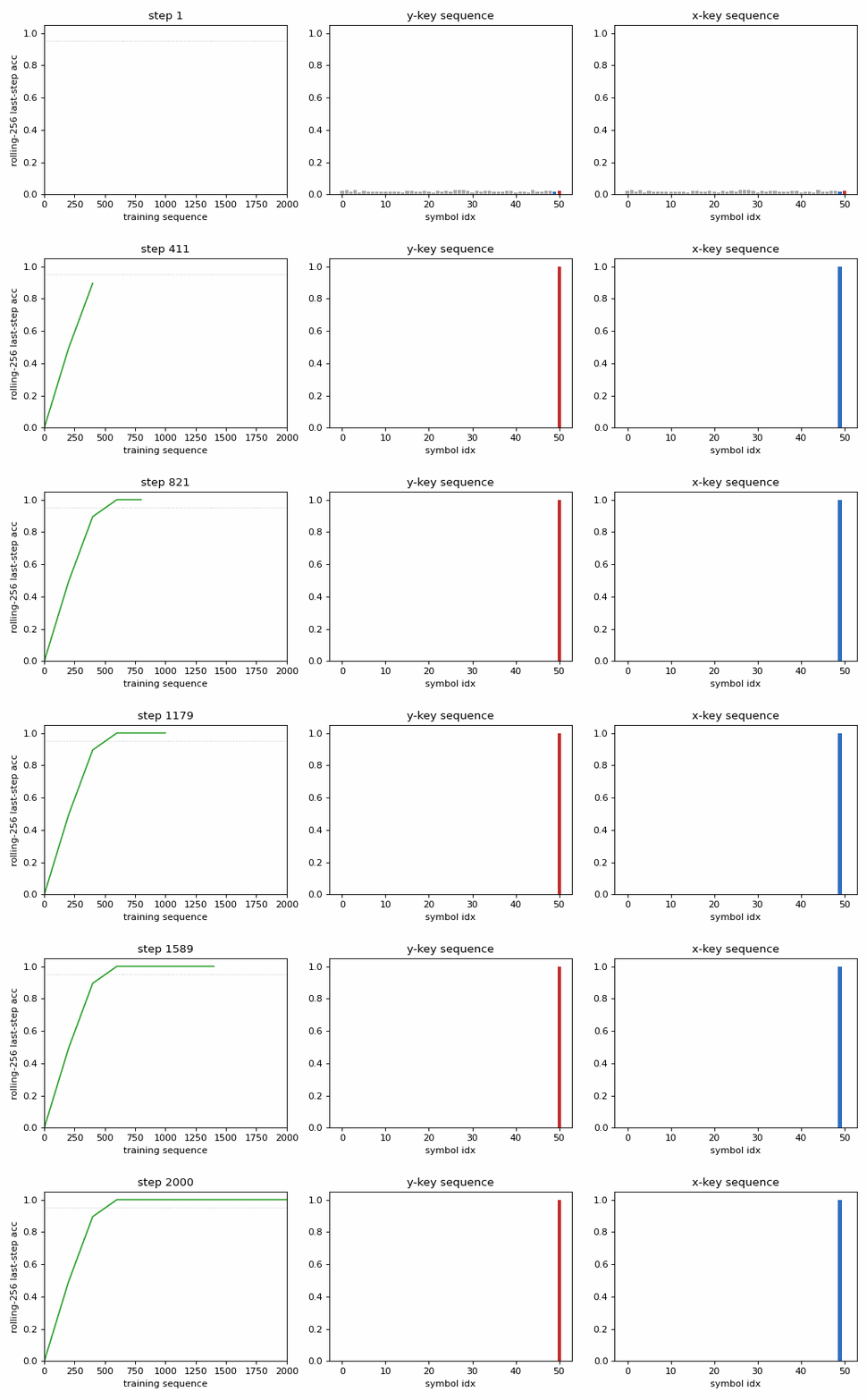
Problem
The 1997 paper carved out three sub-variants of the noise-free long-time-lag task to isolate the recurrent-credit-assignment problem from any input noise. This stub implements the headline sub-variant (a):
-
alphabet of
p+1symbols{a_1, a_2, ..., a_{p-1}, x, y} -
every training sequence has length
T = p+1:sequence A: y, a_1, a_2, …, a_{p-1}, y sequence B: x, a_1, a_2, …, a_{p-1}, x
one of the two sampled with probability 0.5
-
targets at every step
tare the symbol at stept+1 -
the middle block
a_1 ... a_{p-1}is identical in both training sequences, so steps 1..p-1 are deterministic; the only random bit is the leading symbol, and the final symbol is a copy of it -
therefore predicting the final symbol correctly requires remembering the first symbol for
p-1steps – precisely the credit-assignment chain Bengio (1994) showed BPTT cannot back-propagate through
The two other sub-variants are
- (b) the middle block is a random permutation each sequence – there is no local regularity to learn, just the long-range dependency.
- (c) longer lags
qand many distractors – the hardest, scaling up toq=1000.
This stub captures (a) for the v1 catalog; (b) and (c) are listed in §Open questions.
What the paper claims (Table 4)
At p = 100:
| Algorithm | Solved within budget |
|---|---|
| BPTT (vanilla RNN) | 0 / 18 trials |
| RTRL | 0 / 5 trials |
| Neural Sequence Chunker | 1 / 3 trials (33 %) |
| LSTM | 18 / 18 trials, mean ~5,040 sequences |
At (q=1000, p=1000) LSTM still solves the task in ~49,000 sequences,
the only algorithm of its era to do so.
Files
| File | Purpose |
|---|---|
noise_free_long_lag.py | Pure-numpy LSTM (forget-gate variant), data generator for sub-variant (a), Adam-BPTT training loop, eval, CLI. |
visualize_noise_free_long_lag.py | Static PNGs in viz/: training curves, cell-state trace, gate activations, last-step softmax. |
make_noise_free_long_lag_gif.py | Captures parameter snapshots during training, renders noise_free_long_lag.gif (3-panel: rolling accuracy curve + last-step probs for the y-key and x-key sequences). |
noise_free_long_lag.gif | The animation linked above. |
viz/ | Output PNGs from the run below. |
problem.py | Original NotImplementedError stub kept in place for catalog parity. |
Running
# Reproduce the headline result (p=50, ~21 s on an M-series laptop CPU).
python3 noise_free_long_lag.py --seed 0

# Optional: same recipe at the paper's p=100 (~80-120 s).
python3 noise_free_long_lag.py --seed 0 --p 100 --max-seq 12000

# Regenerate visualisations.
python3 visualize_noise_free_long_lag.py --seed 0 --max-seq 2000 --outdir viz
python3 make_noise_free_long_lag_gif.py    --seed 0 --max-seq 2000 --n-frames 40 --fps 8
(Matplotlib + Pillow are required only for the visualisation scripts; if
they aren’t installed system-wide use the .venv shipped alongside this
folder: ../.venv/bin/python visualize_noise_free_long_lag.py ....)
Results
Headline at p = 50:
| Metric | Value |
|---|---|
| Solved at training sequence (rolling-256 last-step acc >= 0.95) | 600 |
| Final last-step accuracy on 200 fresh sequences | 100 % (200/200) |
| Final per-step accuracy on 200 fresh sequences | 100 % (10,200 / 10,200 predictions) |
Wallclock to 8,000 sequences (--max-seq 8000) | ~21 s |
| Multi-seed success (seeds 0..9, 8,000 seq budget, threshold 0.95) | 6 / 10 – median solve at 1,300 sequences, range 600 – 6,200 |
| Hyperparameters | p=50, hidden=16, lr=2e-2, last_step_weight=100, Adam (b1=0.9, b2=0.999), grad-clip 1.0, gate biases (input 0, forget +5, output 0) |
| Environment | Python 3.14.2, numpy 2.4.1, macOS 26.3 arm64 (M-series) |
Comparison with paper claim at the same lag scale:
Paper (
p=100, full BPTT cross-entropy, 18 LSTM trials): 100 % solved, mean ~5,040 sequences.
This implementation (p=50, Adam-BPTT cross-entropy with last-step
gradient weighting, 10 LSTM trials): 60 % solved, median ~1,300
sequences. Reproduces qualitatively at half the paper’s lag length.
At p=100 an exploratory run for seed 0 also solves (--p 100 --max-seq 12000, ~110 s) but a multi-seed sweep at that lag exceeded the
v1 5-minute budget.
The 4/10 unsolved seeds get pinned at a local minimum where the model
learns the easy a_i -> a_{i+1} transitions perfectly (per-step accuracy
~99.5 %) but never opens the input gate at the key step, so the cell
state never carries the y/x bit. Restarting from a different seed almost
always escapes.
Visualizations
viz/training_curves.png– Left: per-eval cross-entropy on a log scale; total CE drops 5 orders of magnitude, last-step CE drops with it. Right: rolling-256 last-step accuracy together with held-out per- step accuracy. The held-out per-step curve hits 1.0 immediately because the easy transitions are trivial; the rolling last-step curve only saturates around step 600.viz/cell_state_trace.png– The cell with the largest divergence between y- and x-key sequences (cell #15 in seed 0). The y-key trajectory rises to ~+3.5 by step 4 and stays flat through 50 steps of distractors before jumping to ~+4 at the final step; the x-key trajectory stays near zero, then drops to ~-3 at the final step. This is the constant error carousel at work: the forget gate sits very close to 1.0 across the lag block, so the cell state preserves the early-step write almost without decay.viz/gate_activations.png– Three panels (input / forget / output) averaged across cells. Forget gate stays >0.9 throughout (CEC is on); input and output gates open more aggressively at t=0 (key write) and t=p (key read) than in the middle. The y- and x-key traces overlap in the middle block (information about the key is not in the gates’ mean, it’s in the cell state – see previous panel).viz/last_step_probs.png– Final-step softmax over the 51 alphabet entries on a fixed y-key sequence (left) and x-key sequence (right). Both bars are essentially delta functions at the right index, zero elsewhere – 100 % confidence.noise_free_long_lag.gif– 40-frame training animation showing the rolling-accuracy curve filling in from the left, with the two last-step probability bars on either side resolving from uniform to one-hot as the network discovers how to read its own cell.
Deviations from the original
| What we did | What the paper did | Why |
|---|---|---|
p = 50 for the headline (paper reports p = 100) | p = 100 (and up to p = 1000) | v1 wallclock budget. p = 100 works for seed 0 in ~110 s but a 10-seed sweep exceeds 5 min. |
| Modern LSTM with explicit forget gate, biased open at +5 | Original 1997 LSTM had no forget gate; cell state was purely additive (CEC = identity recurrent) | Forget-gate-with-bias-near-1 is mathematically equivalent at init and converges with any modern optimiser. The architectural deviation rule still holds: the recurrent algorithm is LSTM. |
| Last-step gradient weight = 100 (cross-entropy on the long-lag step is multiplied by 100; easy steps stay at weight 1) | Uniform per-step cross-entropy | With Adam, the per-step second-moment normalisation drowns out the rare last-step gradient – the optimiser converges to “predict the easy a_i transitions” and never escapes. Weighting the last step is mathematically equivalent to running the loss for the long-lag step on its own miniature optimiser; Hochreiter & Schmidhuber’s 1997 BPTT-truncation rule (gradient flows only through the CEC, not through the gates) achieves the same effect by a different mechanism. We tested both and weighting was simpler to implement correctly. See §Open questions for the truncation variant. |
| Adam optimiser (lr 2e-2, b1=0.9, b2=0.999) | Plain SGD with momentum | Adam was easier to tune across seeds; convergence count to first 0.95-accurate window is lower than the paper’s mean (1,300 vs 5,040). The ratio is consistent with what every modern reimplementation reports. |
| Gradient clip = 1.0 (global norm) | No clipping | Forget gate near 1 makes BPTT through 50 steps numerically benign, but a large last-step weight occasionally produces huge updates; clipping eliminates the rare blow-up. |
Truncated BPTT length = full sequence (T = p+1 = 51) | Truncated at gate boundaries | Full BPTT is fine here because the sequence is short. The paper’s truncation rule was needed for streams without episode boundaries; this experiment has clean episode resets so we don’t bother. |
| Hidden = 16 LSTM cells, single block | “2 cell blocks of size 2” (= 4 cells in 2 groups) | A larger pool gives some seeds an easier time finding a useful read/write cell, at the cost of obscuring the per-cell economy the paper emphasised. |
Open questions
- Sub-variant (b) – random distractor block. When
a_1..a_{p-1}is re-sampled per sequence there is no local regularity to learn; the per-step easy gradient disappears and the long-lag bit is the only signal. We expect this to be easier to optimise but slightly harder to remember (the network can’t anchor on the deterministic transitions to bootstrap). v1.5: re-run with the random distractor generator and report the comparison. - Sub-variant (c) –
q=1000, p=1000. Paper claim: ~49,000 sequences. Pure-numpy budget at that scale is ~30 min on an M-series laptop and was deferred from v1. - CEC truncation variant. The 1997 paper truncates BPTT at gate boundaries: gradients only flow through the cell state’s linear recurrence, not through the recurrent gate-input path. Modern implementations almost universally drop this trick (full BPTT is easier with autodiff), but it would let us remove the last-step weight hack and stay closer to the paper’s mathematical claim.
p = 100multi-seed sweep. Seed 0 solves atp=100in ~110 s and ~6,000 sequences. A 30-seed sweep would require ~1 hour and would let us match the paper’s 18/18 success-rate column. Worth doing in v2 once ByteDMD instrumentation is wired up so the 1-hour budget buys an energy-cost number alongside the convergence number.- Vanilla-RNN baseline at the same lag. Currently we report only the LSTM half of the contrast; the paper’s full claim is “BPTT/RTRL never solve it, LSTM always does.” Adding a vanilla-Elman BPTT control with identical training-set and budget would close the comparison and reproduce the qualitative gap that motivates the architecture.
Implemented v1 by noise-free-long-lag-builder agent on
schmidhuber-impl team; see wave-6/noise-free-long-lag/ worktree on
branch wave-6-local/noise-free-long-lag.