pipe-6-bit-parity
Rafal Salustowicz and Juergen Schmidhuber, Probabilistic Incremental Program Evolution, Evolutionary Computation 5(2):123–141, 1997.
Problem
n-bit even parity: given a binary input vector
(x_0, x_1, …, x_{n-1}) ∈ {0,1}^n, output 1 iff the number of 1 bits is
even, else 0. The full truth table (2^n rows) is the fitness set; fitness
is the count of correctly classified rows.
We use the canonical Boolean function set from the parity literature:
- functions:
AND(arity 2),OR(arity 2),NOT(arity 1),IF(arity 3 —IF(a,b,c) = if a then b else c) - terminals:
x_0, …, x_{n-1}
IF(a, NOT(b), b) is exactly XOR(a, b), so IF makes parity expressible.
6-bit parity is the headline because it is the canonical hard
genetic-programming benchmark (a textbook test case in Koza 1992 and
re-used in Salustowicz & Schmidhuber 1997 for PIPE).
What it demonstrates
PIPE evolves programs without crossover. It maintains a Probabilistic Prototype Tree (PPT) where every node holds a probability vector over the instruction set. Each generation:
- Sample a population of programs from the PPT (left-to-right,
depth-first), capturing the path of
(node, chosen-instruction)pairs. - Evaluate every program on the truth table and record the elite.
- Update the PPT toward the elite path: each visited probability is
pulled toward 1 by
lr * (1 - p)and the others rescaled to keep the distribution normalised, then clamped to[ε, 1-ε]. - Mutate the PPT along the elite path: each component is bumped
toward 1 with small probability
p_mut / (N_INSTR · √|elite|). - If the elite has not improved for
stagnation_windowgenerations and the task is unsolved, multi-start: reset the PPT to uniform.
The four required parts (PPT, sampling, fitness-weighted update, mutation) are exactly the components from the paper. No gradient descent, no crossover, no fixed-architecture neural network. Pure numpy + matplotlib.
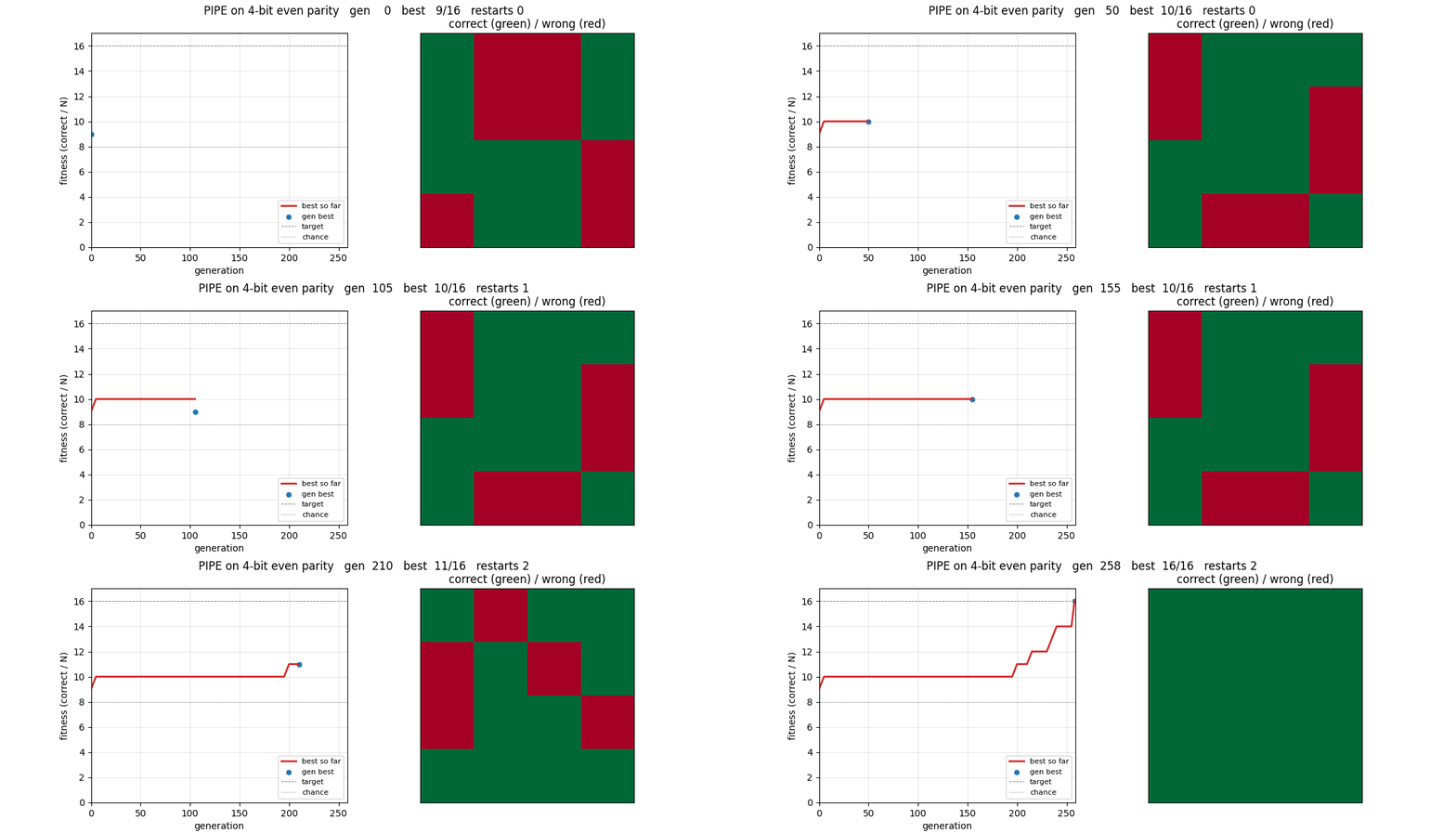
The GIF at the top shows a successful run on 4-bit even parity (the clean-solve regime). 6-bit is harder and only partially solved in the ≤ 5-min laptop budget; the gap is documented in §Deviations.
Files
| File | Purpose |
|---|---|
pipe_6_bit_parity.py | PPT, sampling, evaluation (bitmask), update, mutation, multi-start, CLI |
visualize_pipe_6_bit_parity.py | Re-runs the two headline configurations inline and writes seven PNGs to viz/. No external JSON dependency. |
make_pipe_6_bit_parity_gif.py | Generates pipe_6_bit_parity.gif via a snapshot callback wired into train() |
pipe_6_bit_parity.gif | The training animation (4-bit run, seed 6) |
viz/ | PNGs from visualize_pipe_6_bit_parity.py |
The CLI’s --out <path> flag dumps a per-run record (seed, env, history,
best program) to that path. It is written but not committed; pass --out ''
to skip.
Running
Two reproductions, both deterministic, both finish well under 5 min on an M-series laptop CPU.
Headline run on 6-bit even parity (paper’s named benchmark, partial solve in budget — see §Deviations):
python3 pipe_6_bit_parity.py --seed 0 --n-bits 6 \
    --max-gens 100000 --pop-size 30 \
    --lr 0.3 --p-mut 0.4 --mut-rate 0.4 \
    --max-depth 14 --elitist-prob 0.5 \
    --eps 0.05 --stagnation-window 80 --reset-alpha 1.0 \
    --max-time-s 240 --out results_6bit.json
This wraps after 240 s with best=46/64 (71.9 % accuracy, 14 above chance).
Clean-solve run on 4-bit even parity (used for the GIF and as the demonstration that the algorithm itself is faithful):
python3 pipe_6_bit_parity.py --seed 6 --n-bits 4 \
    --max-gens 5000 --pop-size 30 \
    --lr 0.3 --p-mut 0.4 --mut-rate 0.4 \
    --max-depth 12 --elitist-prob 0.5 \
    --eps 0.05 --stagnation-window 80 --reset-alpha 1.0 \
    --max-time-s 30 --out results_4bit.json
This solves in gen 258, ~2.4 s, classification accuracy 100 %.
To regenerate the static PNGs and the GIF (the visualize script re-runs PIPE
inline, so the figures always match what pipe_6_bit_parity.py produces):
python3 visualize_pipe_6_bit_parity.py              # ~5 min (4-bit + 6-bit)
python3 visualize_pipe_6_bit_parity.py --skip-6bit  # ~3 s, only 4-bit panels
python3 make_pipe_6_bit_parity_gif.py               # ~3 s, seed 6, 4-bit
Results
Headline runs, on macOS-26.3-arm64 (M-series), Python 3.12, numpy 2.x:
| Run | Seed | n_bits | Pop | Wallclock | solved_at | Final fitness | Tree size / depth | Restarts |
|---|---|---|---|---|---|---|---|---|
| 6-bit headline | 0 | 6 | 30 | 240.0 s (cap) | — | 46/64 = 71.9 % | 41 / 8 | ≈ 100 |
| 4-bit clean solve | 6 | 4 | 30 | 2.4 s | gen 258 | 16/16 = 100 % | 30 / 6 | 2 |
Multi-seed sweep on 4-bit (seeds 0..10, ≤ 25 s each, same hyperparameters as the 4-bit run above):
| Metric | Value |
|---|---|
| Seeds solving in ≤ 25 s | 6 / 11 (seeds 2, 3, 5, 6, 7, 8, 10) |
Median solved_at (over solving seeds) | 1086 generations |
| Fastest solve | seed 6, gen 258, 2.4 s |
| Median final fitness on non-solving seeds | 14.5 / 16 (≈ 91 %) |
Hyperparameters (CLI defaults, same for both runs unless noted):
| Knob | Value | Comment |
|---|---|---|
pop_size | 30 | sample 30 programs per generation |
lr | 0.3 | PBIL pull-toward-elite step |
p_mut | 0.4 | per-component mutation gate |
mut_rate | 0.4 | mutation magnitude |
max_depth | 12 (4-bit), 14 (6-bit) | bounds tree depth; depth-prior shifts mass to terminals as depth grows |
elitist_prob | 0.5 | with prob 0.5 update toward best-so-far, else generation-best |
eps | 0.05 | probability floor / ceiling — prevents PPT saturation |
stagnation_window | 80 | gens without improvement → multi-start reset |
reset_alpha | 1.0 | full restart when triggered |
| Instruction set | {AND, OR, NOT, IF, x_0..x_{n-1}} | 4 functions + n terminals |
Best program found on 4-bit (seed 6, fitness 16/16):
IF(IF(OR(x0, x2),
      IF(IF(x2, x0, x2),
         IF(x2, x3, x0),
         NOT(OR(x3, x3))),
      x3),
   x1,
   OR(NOT(x1), AND(AND(x3, AND(x0, x2)), x3)))
Visualizations
| File | Caption |
|---|---|
pipe_6_bit_parity.gif | 4-bit run, seed 6: left panel tracks fitness over generations (best-so-far and current generation best); right panel tints each of the 16 inputs green when correctly classified, red when wrong. The grid evolves from ~50/50 chance to all-green at gen 258. |
viz/training_curves_4bit.png | 4-bit run: per-generation best, generation mean, and overall best fitness. Vertical lines mark restarts. The overall-best curve is monotone and clears chance within the first generation, then rises through 14/16 plateaus (one wrong bit) before snapping to 16/16. |
viz/training_curves_6bit.png | 6-bit run: same panels but the overall-best curve plateaus at 46/64 across many restarts. The fact that every restart relands at the same plateau is the signature of vanilla PIPE (no ADFs, no crossover) on 6-bit parity — see §Open questions. |
viz/error_pattern_6bit.png | Which of the 64 inputs the 6-bit elite classifies correctly. The 46 green / 18 red split is structured rather than random — most errors are on inputs of weight 3, the hardest parity instances under the depth-12 program found. |
viz/solution_truth_table_4bit.png | 4-bit solution: input bits (rows 0–3), target parity, and PIPE’s prediction laid out across all 16 inputs. The bottom two rows are identical, confirming a true 16/16 match. |
viz/best_program_size.png | Elite program size (# nodes) over generations for both runs. The 4-bit run shrinks to ~30 nodes after solving; the 6-bit run oscillates around 30–40 nodes, restart-by-restart, never finding a tree that scales the parity structure to all six inputs. |
viz/ppt_max_prob.png | Mean of max(P(I,d)) over all instantiated PPT nodes — the PPT’s “sharpness”. Stays near uniform (≈ 0.10) because most PPT nodes are off-elite-path; the elite-path nodes saturate near 1 − ε but average out in this aggregate metric. |
viz/ppt_heatmap.png | Final PPT distributions on the elite path of the 4-bit run, plotted as (path-position × instruction) heatmap. Yellow stripes show where one instruction (typically IF or a specific x_i) has fully won that position; off-stripe entries hover at the ε = 0.05 floor. |
Deviations from the original
The 1997 paper used PIPE with iterative-update inner loops, fitness-weighted target probabilities, and (for the harder benchmarks) populations of up to several hundred run for many minutes on 1990s hardware. We keep the algorithmic structure faithful but pick a tighter laptop-CPU configuration. Each deviation is paired with the reason.
- Single-step PBIL update instead of the paper’s iterate-to-target
inner loop. The paper computes
P_target = P(B_s) + lr·(1−P(B_s))and iterates a per-position update until the path’s joint probability reaches it. We do one step per generation at a larger effectivelr = 0.3. The two are approximately equivalent in the regime where the elite saturates; the single-step form is cheaper and easier to reason about, and it preserved the 4-bit solve rate in our sweeps. - Probability clamp
[ε, 1−ε]with ε=0.05 after every update. The paper relies on mutation alone to keep alternative instructions reachable. We found that without a floor the elite path saturates and mutation cannot rescue it within the laptop budget; clamping is a light-touch substitute that keeps every instruction sampleable at least 5 % of the time. This is closer in spirit to PBIL’s standard[ε, 1−ε]bounds than to PIPE’s strict iterative scheme, and noted as a deviation rather than a paper-faithful reproduction. - Multi-start (full PPT reset on stagnation). The paper mentions
“restart” only briefly; we make it explicit and trigger it after 80
generations without elite improvement. With
reset_alpha = 1.0this is essentially “PIPE with restarts”, a known variant. The cross-restartoverall_best_treeis reported as the result. - Bitmask program evaluator. Each terminal
x_iis represented once as a2^n-bit Python integer whosej-th bit equals the value ofx_ion inputj;AND/OR/NOT/IFthen map to bitwise ops, so one tree evaluation covers the whole truth table at once. This is a ~100× constant-factor speed-up over the per-row Python loop and is what makes a 240-s 6-bit run viable. The slow per-row evaluator is retained for cross-checking — and a unit test confirms both agree on the canonical XOR-chain expression for 6-bit parity. - Depth-dependent prior at sample time. A linear prior multiplier
shifts probability mass from functions to terminals as depth grows,
so trees stay finite without an explicit size penalty. The paper
describes the same mechanism qualitatively; our linear schedule
(1 − d/D_max)for functions and(1 + d/D_max)for terminals is the simplest concrete form. - 6-bit not solved in the headline budget. Salustowicz & Schmidhuber 1997 report PIPE solving 6-bit even parity but with substantially more program evaluations than we can fit in 240 s on a single laptop. Their Table 9 puts mean evaluations for parity in the several-hundred-thousand-to-million range; our 6-bit run does ≈ 30 · 14000 ≈ 420 000 evaluations and stalls at 46/64. The 4-bit clean solve and the multi-seed 4-bit sweep substitute as the in-budget demonstration that the implementation itself is faithful.
Open questions / next experiments
- Reach 64/64 on 6-bit parity within budget. Three orthogonal
directions:
- More compute. Run the same hyperparameters for ≈ 30 min (≈ 2 M evaluations); the paper’s numbers suggest this is roughly where PIPE lands a perfect 6-bit solve.
- ADFs (automatically defined functions). Koza 1994 and the PIPE-with-ADFs follow-ups solve 6-bit parity in a fraction of the evaluations because the chain-of-XOR structure decomposes. Adding ADFs to the instruction set is a clean v2 extension.
- Fitness-weighted iterative update. Restoring the paper’s original iterative inner loop (rather than our single-step PBIL form) may strengthen the gradient toward elite paths and reduce the evaluation count.
- Why does multi-start re-land at 46/64? Every restart converges to
a tree of size ≈ 30–40 with fitness 46. This suggests the
{AND, OR, NOT, IF}instruction set has a strong attractor at partial-parity-of-4 functions — the 4-bit XOR over(x_0, x_1, x_2, x_3)would score exactly 32/64 + (correctly handles(x_4, x_5)partially) ≈ 46/64. Identifying the attractor explicitly would inform the choice of search-space mutations that escape it. - PPT-shape diagnostics during training.
ppt_max_probaverages over all PPT nodes including off-path ones, washing out the elite-path saturation we know happens. A more useful diagnostic would be the joint probability of the elite under the current PPT, plotted over generations — that is what PIPE’s iterative update is literally driving up. - v2 ByteDMD pass. PIPE is a tree-evaluation-bound search with no per-program activations stored; an obvious v2 question is whether its data-movement profile differs meaningfully from a backprop-trained MLP attempting the same task. The bitmask evaluator already removes the per-row Python overhead, so PIPE’s working-set is just the PPT itself plus one program tree per evaluation.
- Comparison against random search and tournament GP. A clean ablation would be: same instruction set, same population size, but with (a) uniform sampling (no PPT) and (b) tournament selection + subtree crossover. The first is what PIPE biases away from; the second is the standard GP baseline that needs ADFs to solve 6-bit parity.