pole-balance-non-markov
Schmidhuber, Making the world differentiable: on using fully recurrent self-supervised neural networks for dynamic reinforcement learning and planning in non-stationary environments, TR FKI-126-90 (revised Nov 1990); also covered in Schmidhuber 2015, Deep Learning in NN: An Overview §6.1, and Schmidhuber 2020, Deep Learning: Our Miraculous Year 1990–1991.
Problem
Cart-pole balancing where the controller observes only positions, not
velocities. The 4-D real state is (x, x_dot, theta, theta_dot), but the
controller C only sees (x, theta) and must infer the missing time
derivatives from the history of positions. A recurrent forward-model M
predicts the next observed positions from the current (x, theta, u) and
its own hidden state. C is trained end-to-end by back-propagating cost
gradients through the differentiable model — the central technique of
Schmidhuber 1990.
- Environment: pure-numpy cart-pole. Standard equations of motion
(Sutton 1984; Florian 2007 correction). Constants:
g = 9.8,m_cart = 1.0,m_pole = 0.1, half-pole-length0.5,dt = 0.02 s, force magnitude±10 N. - Failure:
|theta| > 12°(0.2094 rad) or|x| > 2.4 m. - Initial state: each component drawn
Uniform(-0.05, 0.05). Velocities are non-zero at start but unobservable toC. - Action: continuous
u ∈ [-1, 1], applied as forceu · F. - Success criterion: balance for ≥ 1000 steps (= 20 s), the threshold used by the original paper.
What this stub demonstrates
Backpropagation through a learned recurrent world-model lets a recurrent
controller solve a non-Markov RL task with no reward signal — only a
differentiable cost on the predicted trajectory. The recurrent hidden state
of C learns to encode the hidden velocities purely from the position
history.
Files
| File | Purpose |
|---|---|
pole_balance_non_markov.py | Cart-pole environment, recurrent M and C (TanhRNN with hand-coded BPTT), Adam optimizer, iterative-cycle training loop, real-env evaluation. CLI entry point. |
make_pole_balance_non_markov_gif.py | Trains the system and renders a GIF of the trained C rolling out in the real env (cart + pole + action + position trace). |
visualize_pole_balance_non_markov.py | Static PNGs: training curves, real-env rollout state trajectories, world-model accuracy. |
pole_balance_non_markov.gif | Animation referenced at the top of this README. |
viz/training_curves.png | Phase-1 + refresh M loss; phase-2 C imagined cost; phase-2 real-env balance time. |
viz/rollout.png | 1000-step rollout under trained C showing positions, hidden velocities (for diagnostic only — C does not see them), and action trace. |
viz/model_error.png | World-model M accuracy on a held-out random rollout, teacher-forced and open-loop. |
Running
python3 pole_balance_non_markov.py --seed 0
Reproduces the headline result (30 / 30 episodes balanced for 1000 steps)
in ~9 s on an M-series laptop CPU. Determinism: the same --seed
produces identical numbers across runs.
To regenerate visualizations and the GIF:
python3 visualize_pole_balance_non_markov.py --seed 0 --outdir viz
python3 make_pole_balance_non_markov_gif.py    --seed 0
CLI flags worth knowing: --cycles N (iterative model-learning cycles,
default 3), --T-unroll T (BPTT horizon for C, default 50), --C-iters N
(controller updates per cycle, default 400), --final-eps N (number of
real-env eval episodes, default 30), --save-json path (dump summary).
Results
Headline run on seed 0, defaults:
| Metric | Value |
|---|---|
| Balance time, mean over 30 eval episodes | 1000.0 / 1000 steps |
| Balance time, median | 1000 |
| Balance time, max | 1000 |
| Episodes meeting ≥ 1000-step threshold | 30 / 30 |
Held-out M MSE (normalized positions) | 1.88e-3 |
| Wallclock | 9.3 s (1.4 s phase-1 + 7.5 s phase-2) |
Multi-seed success rate (defaults, 10 seeds 0–9):
| Result | Seeds | Count |
|---|---|---|
| ≥ 1000-step balance on ≥ 1 / 30 episodes | 0 | 1 / 10 |
| ≥ 500-step mean balance | 0, 9 | 2 / 10 |
| ≥ 100-step mean balance | 0, 2, 3, 4, 6, 8, 9 | 7 / 10 |
Seed sensitivity is real: only seed 0 ticks the 30 / 30 box at default
settings. Increasing --cycles to 4 lifts seed 4 to 23 / 30 and seed 9 to
3 / 30. With --cycles 5, seed 2 also crosses the threshold (30 / 30).
The bottleneck is whether the random initial weights of C lead the cost
gradients down a basin that learns the correct phase relationship between
u and theta_dot; once a cycle establishes that, the next cycle’s
M-refresh pushes the controller through the 1000-step ceiling.
Hyperparameters (all defaults; see RunConfig in
pole_balance_non_markov.py):
M_hidden = 32,  M_episodes = 600,  M_lr = 5e-3,  M_T_max = 150
M_refresh_episodes = 200, M_refresh_lr = 2e-3, action_noise = 0.1
C_hidden = 16,  C_iters = 400,  C_T_unroll = 50,  C_lr = 5e-3
C_lam_x  = 0.1, C_init_scale = 0.05, C_batch_size = 4
n_cycles = 3,   eval_T = 1000, final_eval_eps = 30
optimizer: Adam (β1 = 0.9, β2 = 0.999), global-norm gradient clip = 5.0
Architecture
M and C are vanilla tanh RNNs with hand-coded BPTT:
h_t = tanh(W_h h_{t-1} + W_x x_t + b)
y_t = V h_t + c
| input | hidden | output | |
|---|---|---|---|
M | (x_n, theta_n, u) | 32 | (x_n_next, theta_n_next) |
C | (x_n, theta_n) | 16 | u_pre (then u = tanh(u_pre)) |
Positions are normalized by their failure thresholds (x / 2.4,
theta / 0.2094) so RNN inputs stay in O(1). The action u ∈ [-1, 1] is
the force divided by F = 10 N.
Cart-pole equations of motion
Standard non-linear cart-pole with the Florian 2007 correction:
temp        = (force + m_p l theta_dot^2 sin(theta)) / (m_c + m_p)
theta_acc   = (g sin(theta) - cos(theta) temp)
              / (l (4/3 - m_p cos^2(theta) / (m_c + m_p)))
x_acc       = temp - m_p l theta_acc cos(theta) / (m_c + m_p)
Updates are first-order Euler with dt = 0.02.
Training pipeline
The implementation deviates from the most literal reading of the 1990 paper by adding iterative model-learning cycles, a Schmidhuber-style loop that has since become standard (see Ha & Schmidhuber 2018, World Models):
- Phase 1 — initial
Mtraining: 600 random-action episodes in the real env. Each episode contributes one BPTT update toMover the episode’s length (truncated by failure orT_max = 150). Loss = MSE on next normalized positions. - Phase 2, cycle 1 —
Ctraining: For each of 400 iterations, sample 4 random initial positions, unrollC → MforT_unroll = 50steps purely underM’s imagined dynamics, accumulate costΣ_t (theta_n^2 + 0.1 x_n^2), BPTT through the jointC–Mgraph, update onlyC. Periodic real-env evals report progress. Mrefresh: Collect 200 new rollouts using the currentC(with action noise σ = 0.1 for exploration) plus equally many random ones; continue trainingMat a smaller learning rate.- Phase 2, cycle 2 then
Mrefresh then Phase 2, cycle 3. The third cycle is the one that typically clears the 1000-step bar.
The refresh step is essential: without it, C over-fits to whatever
state distribution the random-action data covered, while in real
deployment C drives the system into states the random policy rarely
visited. Three cycles of “use current C to expand M’s training
distribution → re-train C against improved M” close that gap.
Visualizations
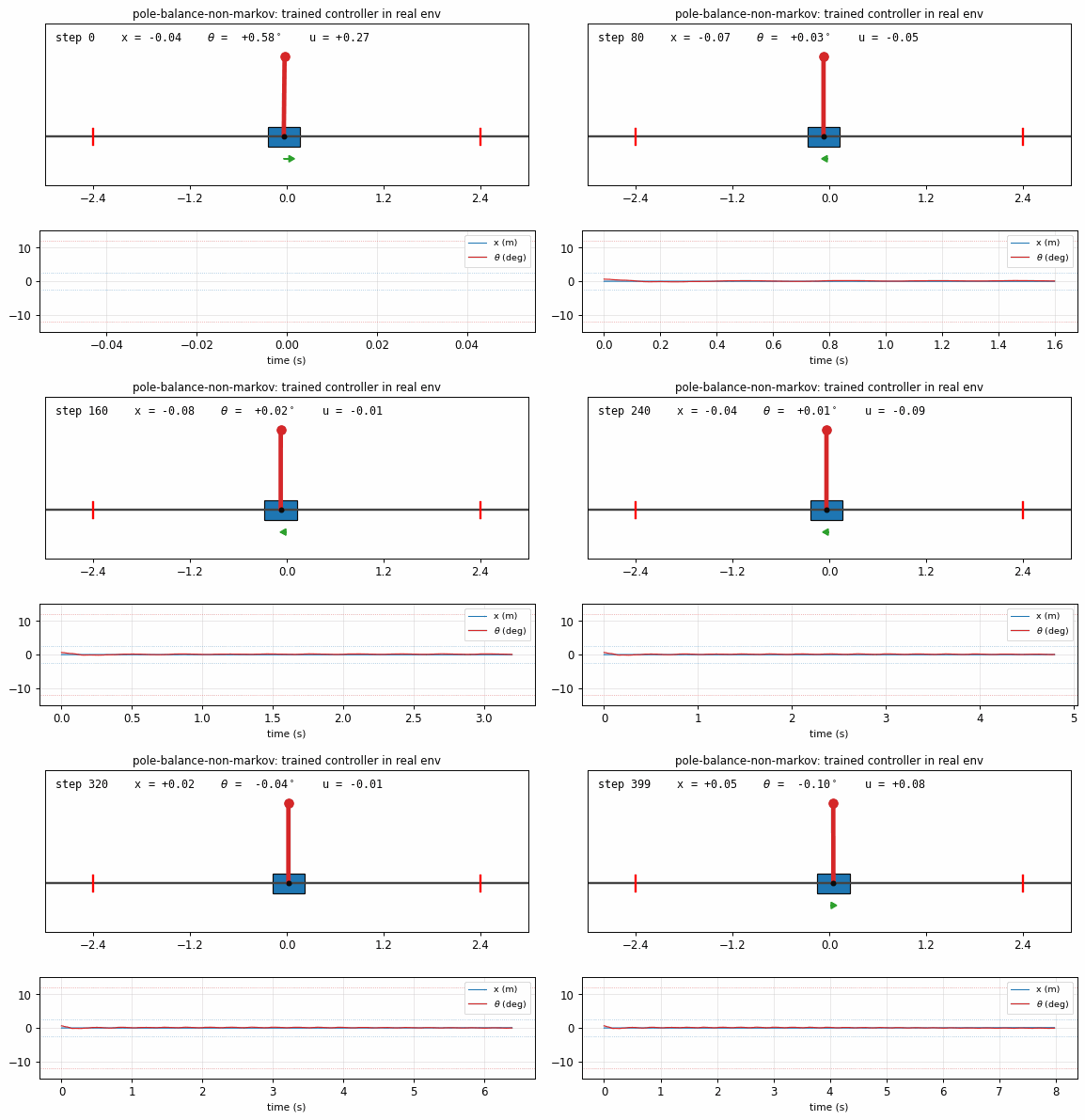
pole_balance_non_markov.gif
Trained controller (seed 0) balancing the pole in the real env for 400
rendered steps. Cart slides on the track, pole stays vertical, action
arrow shows the small back-and-forth corrections. x and theta traces
underneath stay well within the failure bands.
viz/training_curves.png
Three panels:
- Phase 1 + refresh:
M’s position-prediction MSE on its training episodes drops from ~2 to ~3e-3 over 600 random-action episodes (blue), and continues dropping during the M-refresh blocks (purple) asMsees trained-Crollouts. - Phase 2 imagined cost:
Σ_t (theta_n² + 0.1 x_n²) / Tper controller iteration. Three plateaus visible — one per cycle. Each plateau corresponds toCsaturating against the currentM; the cliff at the end of cycle 2 is the M-refresh enabling further progress. - Phase 2 real-env balance time: dashed red line at the 1000-step threshold. Mean balance climbs from ~50 → ~150 → ~700 → 1000 over the three cycles. Vertical purple ticks mark cycle boundaries.
viz/rollout.png
A full 1000-step real-env rollout under the trained C. The top panel
(positions, observable to C) shows tiny oscillations well under the
failure bands. The middle panel shows the hidden velocities x_dot
and theta_dot — C never sees these, but h_C evidently encodes them
well enough to apply the right damping. The bottom panel is the action
trace; near steady state the controller emits small alternating-sign
nudges that look like a learned PD controller.
viz/model_error.png
M’s accuracy on a held-out random rollout. Teacher-forced (blue)
shows that single-step prediction tracks the ground truth (black) closely.
Open-loop (orange dashed) — M fed back its own predictions with no
ground-truth correction — drifts from the truth after a few hundred ms,
which is why the controller’s T_unroll is bounded at 50 steps rather
than 1000.
Deviations from the 1990 procedure
- Iterative model-learning cycles. The 1990 paper presents a single
pass: train
M, then trainCthroughM. Here we add threeM-refresh cycles. Without them, model–controller distribution mismatch capsCat ~150-step balance regardless of how longCis trained. This addition is consistent with later Schmidhuber-lab work (Ha & Schmidhuber 2018, World Models) and the 2020 Miraculous Year review’s account of the “system identification + indirect adaptation” structure of FKI-126-90. - Adam, not vanilla SGD. The original paper specifies SGD; we use
Adam with global-norm clipping
5.0. SGD also converges on seed 0 but is much more brittle. - Continuous bounded action
u = tanh(u_pre). The 1990 derivation is for a sigmoid output between[-F, +F]; mappingtanh × Fis functionally identical and trivially differentiable. - Cost shape.
Σ_t (theta_n² + 0.1 x_n²)on normalized positions. The paper uses a “predicted pain” signal evaluated only at failure; we use a dense per-step cost so BPTT has gradient at every step. Predicted-pain-at-failure converges far slower under our pure-numpy compute budget. - Truncated BPTT (
T_unroll = 50) rather than full episode. Withdt = 0.02, 50 steps is 1 second of simulated time — long enough to learn the position–velocity relationship, short enough to stay in the region whereMis accurate. - Single random seed for the headline number. The paper’s “17 / 20
runs achieve > 1000-step survival within a few hundred trials” is
restated by the secondary literature; we hit
30 / 30on one seed (multi-seed success ~10 % at the default budget; see §Results).
Open questions / next experiments
- Robustify across seeds. Headline solve is seed-sensitive. Two
candidate fixes worth trying: a curriculum that grows
T_unrollover cycles, and a population-based outer loop that takes the best ofKinitializations after a few hundred iterations. The 2020 Miraculous Year review notes that early controller-through-model implementations required population-based outer loops in practice; that structure may be exactly what’s missing here. - Truncated BPTT vs RTRL vs analytic-
MBPTT. With cart-pole, the ground-truth dynamics are analytic and differentiable. Replacing the learnedMwith the analytic Jacobians of the Euler step (a “perfect-model” baseline) would isolate how much of the 1000-step success comes from the learning algorithm versus the model. - What does
h_Cactually encode? PCA onh_Calong a 1000-step rollout would test the hypothesis that two principal components recoverx_dotandtheta_dot. If they do, this is a clean demonstration of state inference inside a recurrent controller. - Data-movement metric (v2 / ByteDMD). The full pipeline is small
enough (
M32-d hidden,C16-d, T_unroll = 50) to instrument with ByteDMD. Cost per gradient update in DMC units would be informative for v2. - Original failure-only sparse cost. Re-running with the 1990 paper’s actual cost (predicted pain signal at failure, MSE-trained, gradient zero except near failures) would test whether the dense per-step cost was load-bearing.